ZTF Summer Students
Meet the young people who explore the dymanic universe with us
Shreyashi Manna
Summer Project: Photometric and morphological behavior of near-Sun asteroids
Can you share what your project is about?
The summer project under Dr. Quanzhi Ye, still ongoing, investigates a sample of 394 asteroids with perihelion distances q > 0.4 AU to study their behavior in the near-Sun environment. Archival data from the Zwicky Transient Facility (ZTF) is used to access exposure catalogs for each object, extract images, and perform detailed photometric analysis. The primary aim is to identify signatures of mass-loss, such as tails or comae, indicating material shedding. By examining brightness variations and activity patterns, the project seeks to characterize the triggers and behavior of mass-loss and to determine its prevalence within this population. Asteroids are classified according to their active or inert state, providing insights into their physical properties, structural integrity, and response to extreme solar radiation. This research enhances understanding of the processes affecting small bodies in the most intense regions near the Sun and informs the broader study of the physical thresholds and conditions under which near-Sun asteroids exhibit activity.
If you were not busy with your summer research, how would you have spend your summer?
If I weren’t a summer student, I would have spent my summer exploring my deeper interests in astronomy, particularly observational astrophysics, with a focus on exoplanetology, stellar evolution, and small bodies research. I would have worked on improving my current knowledge and taken courses on relevant topics to deepen my understanding. Outside of academia, I might have spent long breaks painting while stargazing or tried baking, perhaps even attempting a three-tier cake.


Samridth Tiwari
Indian Institute of Technology, Bombay
Mentor: Quanzhi Ye (University of Maryland, USA)
Summer projects: Lightcurves of fast moving near-Earth asteroids
Can you share what your project is about?
The Zwicky Transient Facility survey captures thousands of images while tracking the stars, and asteroids happened to streak through these frames by chance. Are these "accidental" streaks useful? The answer is yes. The streak isn't uniform for bright enough sources, it encodes the asteroid's rotation. Imagine an elongated boulder tumbling through space: when the long side faces us, we get more light; when it rotates to show its narrow side, less light. This brightness variation is encoded right into the streak. I queried JPL Horizons ephemerides for ~35,000 known NEAs across ZTF's 2018–early 2025 archives, identifying 44,918 observation windows where asteroids streaked (V >21, motion <10"/min). The pipeline slices each streak into seeing-sized segments, performs adaptive aperture photometry, and extracts time-resolved light curves from single 30-second exposures. Using Lomb-Scargle periodogram analysis, we determine rotation periods—fast-spinning asteroids must have internal cohesion, since loose rubble piles held together only by gravity would fly apart from centripetal forces. This reveals their structural nature, with applications in future asteroid mining missions.
If you were not busy with your summer research, how would you have spend your summer?
I started this back in January and worked remotely the whole time, so my summer was not much different honestly. Though I have gotten into trekking lately, and if I had the time, I definitely would have been off in the Himalayas somewhere instead of debugging streak photometry algorithms.
Amaliya Atamalibekova
Summer Project: Search for Sub-Threshold Gamma-Ray Bursts In a Flux-Limited Ic-BL Supernova Sample
Can you share what your project is about?
The project investigates whether faint sub-threshold gamma-ray bursts (GRBs) are associated with Type Ic broad-lined supernovae (Ic-BL SNe), which are high-energy stellar explosions sometimes linked to GRBs. Using a flux-limited sample (>19 mag) of 85 Ic-BL SNe from the Zwicky Transient Facility Bright Transient Survey (BTS), I estimated explosion times with the HAFFET light-curve fitting package and cross-matched them with Swift BAT sub-threshold triggers from the GUANO and HEASARC archives. For events with sufficient exposure, I calculated flux upper limits within 48 hours of explosion. While no coincident GRBs were found, the typical upper limit of 2.9 × 10⁻⁷ erg/s/cm² is comparable to the flux of known low-luminosity GRBs (10⁻⁷–10⁻⁸ erg/s/cm²), suggesting that any associated GRBs are not ruled out and may have simply been too faint to detect.
If you were not busy with your summer research, how would you have spend your summer?
I would have taken a course in Japanese over the summer. I also would have spent some time preparing for my future courses, relaxing, hanging out with friends, and reading more books.

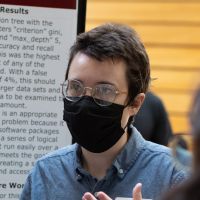
Nat Sutton
Project: Searching for eclipsing white dwarf binaries with SCoPe
Can you share what your project is about?
My project was related to the ZTF Source Classification Project (SCoPe), which trains neural network and machine learning (ML) algorithms to perform classification of variable ZTF sources using a manually constructed training set containing 170,632 light curves. However, due to the great number of types of variable sources, not all types are feasible to be incorporated into the algorithm. My project involved writing an algorithm to identify one such non-incorporated type, eclipsing white dwarf binaries, without redesigning the original algorithm.
If you were not busy with your summer research, how would you have spend your summer?
Had I not been a summer student this year, I would have sought employment local to my area.