


Observers on the Hale Telescope: April 15 and 16, 2019
Eric Mamajek
(Jet Propulsion Laboratory)
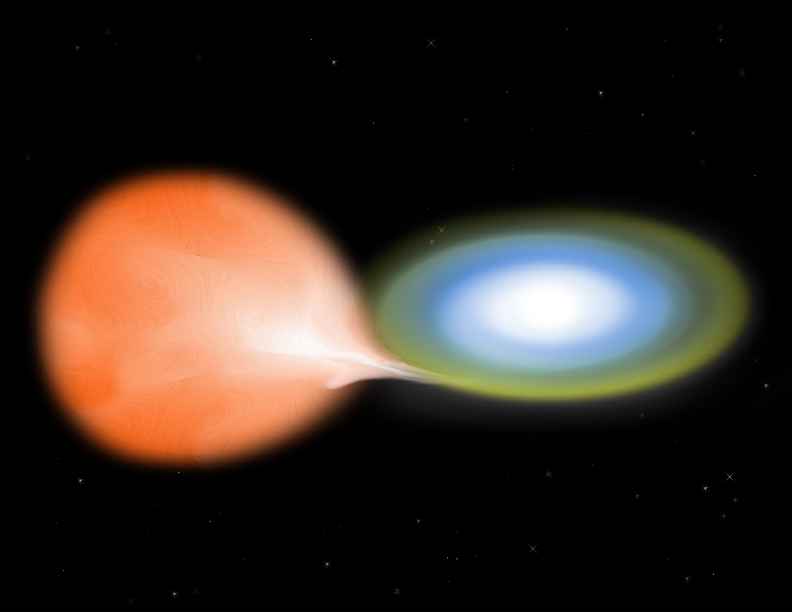 In this artist's impression, a hot white dwarf accretes material from a cool dwarf companion star. In this exchange, material accumulates on the surface of the white dwarf until, at a certain temperature and pressure, a fusion explosion causes a rapid brightening we see as a classical nova. The two stars often survive the cataclysm to repeat the cycle many centuries later. (JPL/Caltech) |
Nearby Ultracool Dwarf Stars: An ultra-cool dwarf star is an object of spectral class M or L with a temperature of 4,400F or less. Warmer only than brown dwarfs, this class makes up 15% of the objects near the Sun. And due to their low mass and small formation disks, these stars may well host large populations of Earth-like planets. Mamajek will use the Triple Spectrograph to examine a sample of these stars. He is concerned with radial velocities, rates of rotation and other characteristics. Since it is likely that many are accompanied by unseen planets, this study seeks to discover the attributes of such host stars. |

