


Observers on the Hale Telescope: December 11, 2022
Mike Brown
(California Institute of Technology)
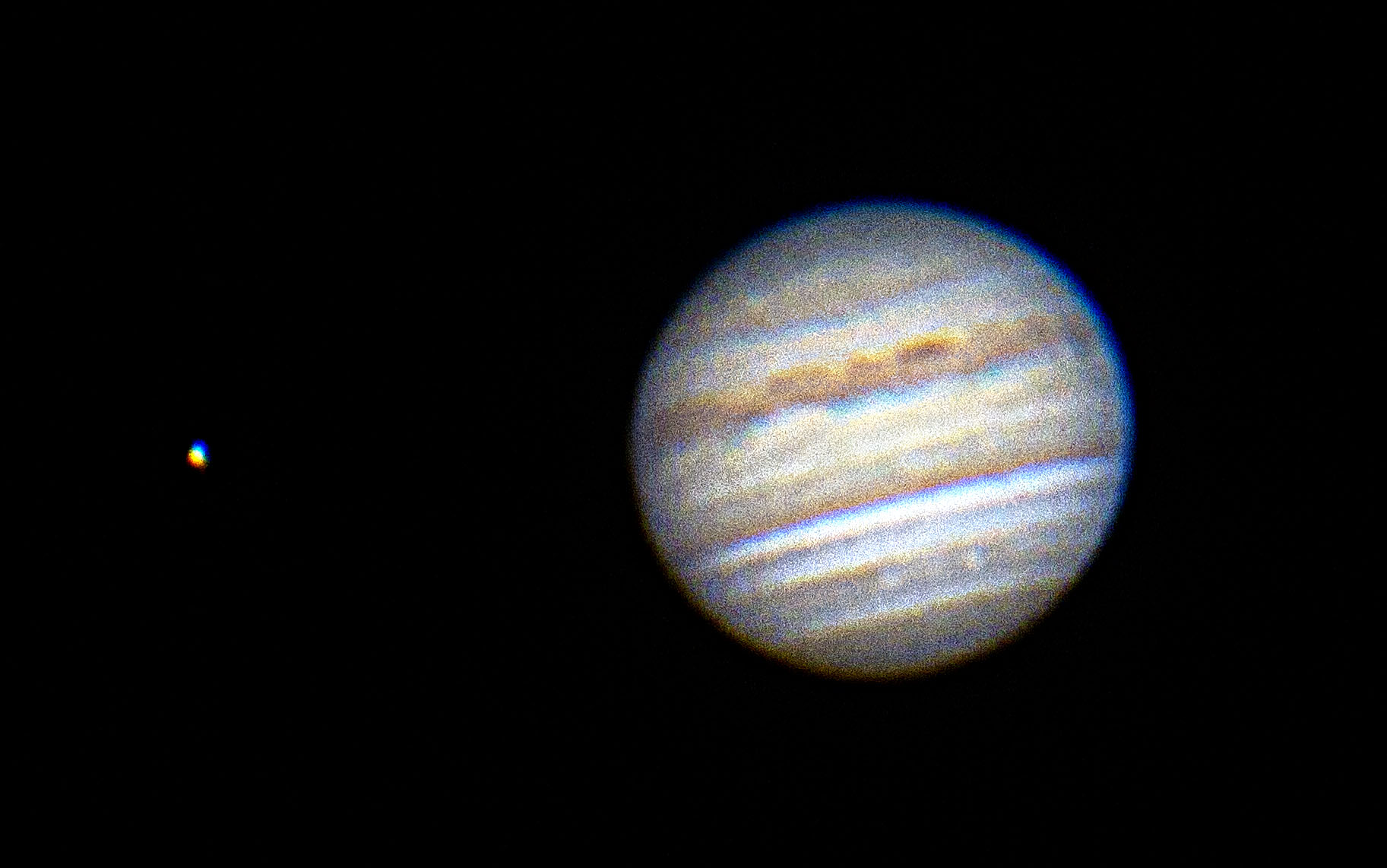 Jupiter with its moon Europa taken by Observatory docent Kin Searcy on June 2, 2018. Searcy used Palomar's 60-inch F/8.75 Ritchy-Chretien telescope with a Canon 6D DSLR at its Cassegrain focus. Europa is slightly smaller than our Moon and orbits less than half a million miles from Jupiter. Under its icy surface, Europa may have a liquid ocean kept warm by its tidal interactions with Jupiter and its two outer moons, Ganymede and Callisto. (K. Searcy) |
Evolution of the Early Solar System: Apparently, the Solar System underwent a period of instability early in its history. This event moved the giant planets inward and scattered small bodies throughout the system, a distrubance that may have thrown distant Kuiper Belt objects into the inner Solar System. Brown suspects that Jupiter's Trojan asteroids are Kuiper Belt objects. Brown will use WIRC, a wide field infrared camera, to charaterize these Trojan asteroids. If they resemble Kuiper Belt objects, it would mean these asteroids have migrated, a conclusion that would change our understanding of the formation of the Solar System. |

