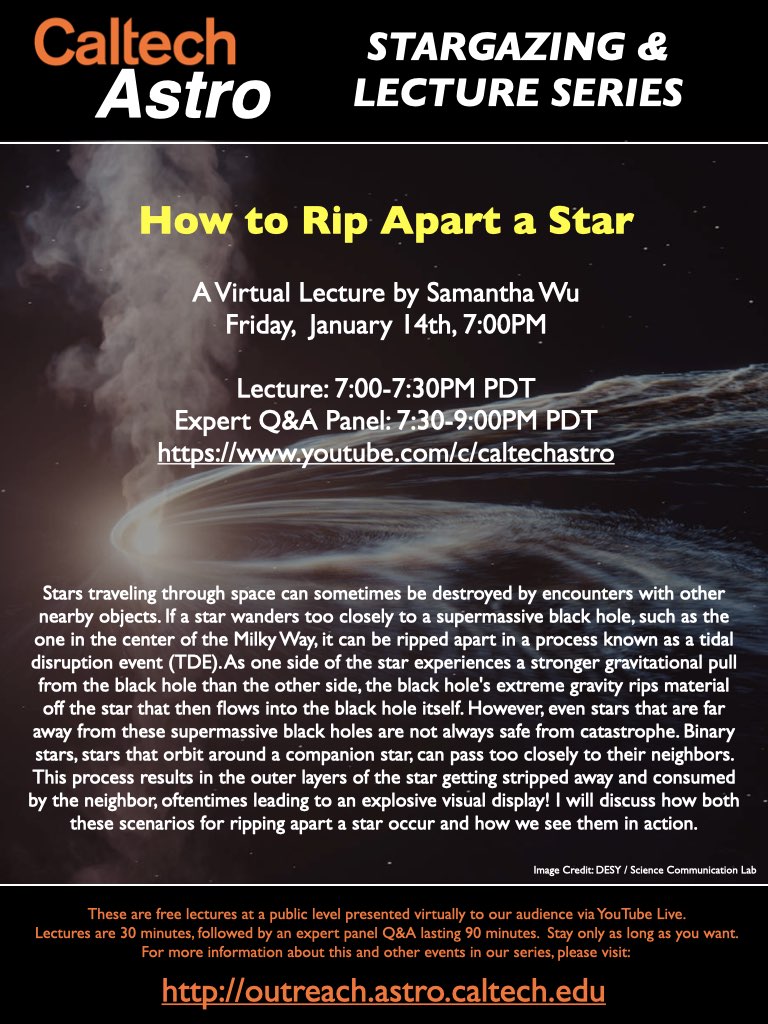
---+ January 14, 2022 7-9PM *Event Type*: [[PublicLectures][Lecture and Stargazing]]<br> *Title*: How to Rip Apart a Star<br> *Lecturer*: Samantha Wu<br> *Position*: PhD Candidate<br> *Institution*: Caltech<br> *Abstract*: <br> Stars traveling through space can sometimes be destroyed by encounters with other nearby objects. If a star wanders too closely to a supermassive black hole, such as the one in the center of the Milky Way, it can be ripped apart in a process known as a tidal disruption event (TDE). As one side of the star experiences a stronger gravitational pull from the black hole than the other side, the black hole's extreme gravity rips material off the star that then flows into the black hole itself. However, even stars that are far away from these supermassive black holes are not always safe from catastrophe. Binary stars, stars that orbit around a companion star, can pass too closely to their neighbors. This process results in the outer layers of the star getting stripped away and consumed by the neighbor, oftentimes leading to an explosive visual display! I will discuss how both these scenarios for ripping apart a star occur and how we see them in action. <br><br> <img src="%ATTACHURLPATH%/20220114V.jpg" alt="20220114V.jpg" width="768" height="1024" />
Attachments
Attachments
Topic attachments
I
Attachment
History
Action
Size
Date
Who
Comment
jpg
20220114V.jpg
r1
manage
188.4 K
2022-01-07 - 20:41
OutreachAdmin
This topic: Main
>
WebHome
>
Schedule
>
20220114
Topic revision: r1 - 2022-01-07 - OutreachAdmin
Copyright © 2008-2025 by the contributing authors. All material on this collaboration platform is the property of the contributing authors.
Ideas, requests, problems regarding TWiki?
Send feedback