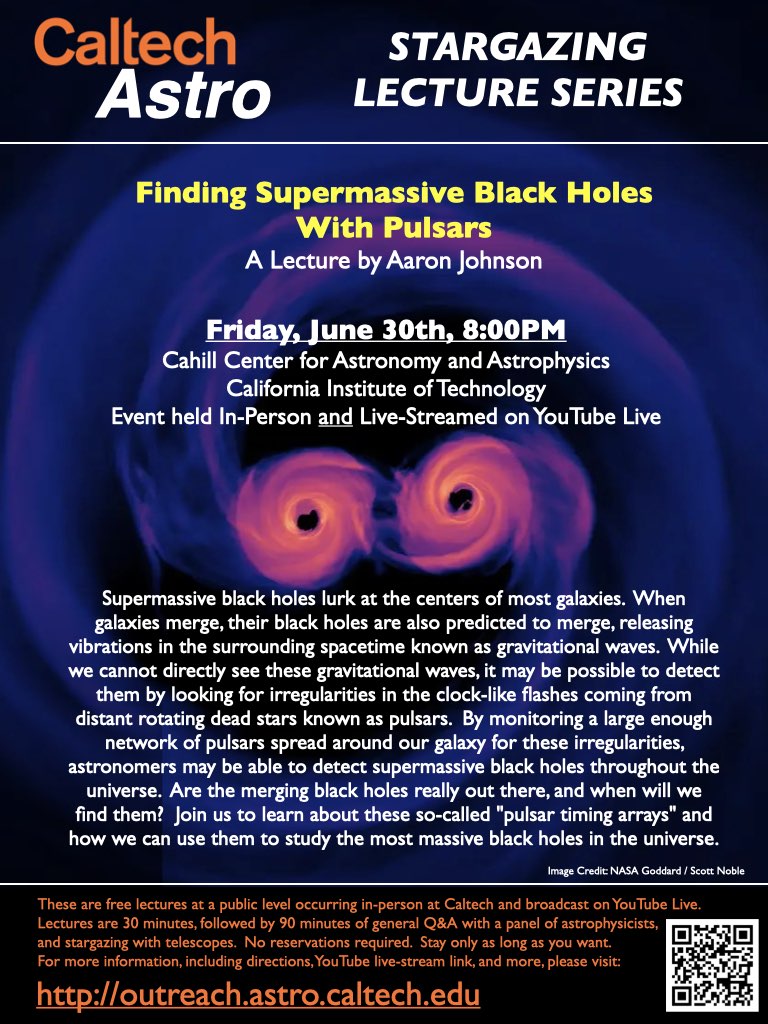
---+ June 30, 2023 8-10PM *Event Type*: [[PublicLectures][Lecture and Stargazing]]<br> *Title*: Finding Supermassive Black Holes with Pulsars<br> *Lecturer*: Aaron Johnson<br> *Position*: Postdoctoral Fellow<br> *Institution*: Caltech<br> *Abstract*: <br> Supermassive black holes lurk at the centers of most galaxies. When galaxies merge, their black holes are also predicted to merge, releasing vibrations in the surrounding spacetime known as gravitational waves. While we cannot directly see these gravitational waves, it may be possible to detect them by looking for irregularities in the clock-like flashes coming from distant rotating dead stars known as pulsars. By monitoring a large enough network of pulsars spread around our galaxy for these irregularities, astronomers may be able to detect supermassive black holes throughout the universe. Are the merging black holes really out there, and when will we find them? Join us to learn about these so-called "pulsar timing arrays" and how we can use them to study the most massive black holes in the universe. <br><br> <img src="%ATTACHURLPATH%/20230630V.jpg" alt="20230630V.jpg" width="768" height="1024" />
Attachments
Attachments
Topic attachments
I
Attachment
History
Action
Size
Date
Who
Comment
jpg
20230630V.jpg
r1
manage
202.3 K
2023-06-23 - 17:39
OutreachAdmin
This topic: Main
>
WebHome
>
Schedule
>
20230630
Topic revision: r3 - 2023-06-23 - OutreachAdmin
Copyright © 2008-2025 by the contributing authors. All material on this collaboration platform is the property of the contributing authors.
Ideas, requests, problems regarding TWiki?
Send feedback