General Overview of SHARC-II
Introduction
SHARC-II operates at the Caltech Submillimeter Observeratory (CSO). It is the world's first facilty "CCD-style" bolometer array, and employs "pop-up" detector technology to form an 12x32 pixel array. Unlike many other bolometer arrays, SHARC-II does not (typically) use chopping to remove the sky background. By sampling the bolometers every 33msec, we can use the "total power" data to estimate the sky contribution and remove it in software.
Approximately 85%
of the 384 bolometers work well. Each pixel has an extent of 4.85 arcseconds, resulting
in a 2.59 arcminute x 0.97 arcminute field of view. (Pixel scale updated
Feb. 2003.)
The beam size with good focus and pointing is 8-9 arcseconds (full-width, half-maximum) at 350 microns.
Filters
SHARC II has 3 filters in a manually-operated wheel: 350 microns, 450 microns, and 850 microns.
We observe nearly background-limited performance at 350 microns and expect the same at 450 microns.
At 850 microns, we expect an NEFD of about 1-2 Jy s1/2 -- 10-20x worse than SCUBA.
We anticipate very little observing at 850 microns.
Sensitivity and Time Calculation Basics
Deep SHARC II integrations require tau(225 GHz) <= 0.05. Statistically
speaking, this happens 10% of the time in "summer" (May - November) and 27%
of the time in "winter" (December - April). During tau(225 GHz) = 0.05,
the NEFD at 350 microns at 1.3 airmasses is 1 Jy s1/2 At 450 microns,
we expect a similar NEFD. Here are some example sensitivity estimates for
1 field of view, assuming the stated weather and airmass, and assuming 50%
loss of time due to overheads (writing data, pointing, calibration, filling
in bad pixels):
time   1-sigma rms
-----  -----------
 1 hr    24 mJy
 3 hr    14 mJy
10 hr     7 mJy
The NEFD in other conditions can be estimated by:
NEFD = 1 Jy s1/2 * exp(25*tau225*airmass - 1.6)
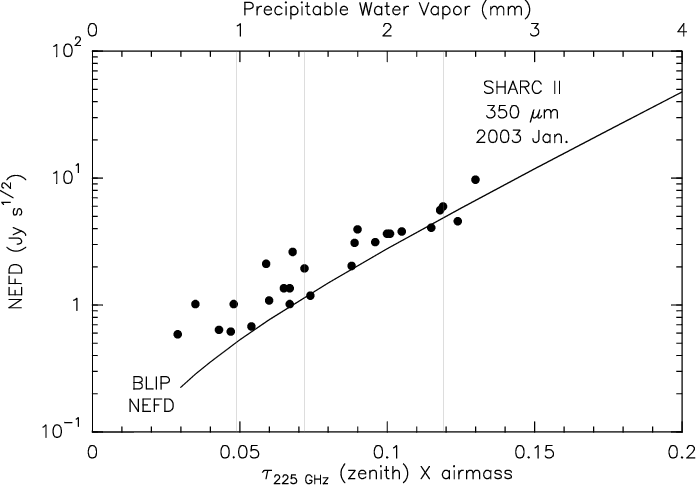
Preliminary 350 micron NEFD measurements (points) from the Jan. 2003
commissioning run compared to the theoretical expectation (line). We confirm
the performance of ~1 Jy s
1/2 for tau(225 GHz) = 0.05.
We do not yet have NEFD measurements at 450 microns.
Field Rotation
SHARC II sits on an instrument rotator, which in principle can be used
to correct for parallactic angle rotation. The user should verify that the
actual rotator position (APA on antenna monitor) is close to the requested
rotator position (RPA), and also watch out for rotation-dependent pointing
offsets. Cable restrictions are fairly minor if things are set up well,
but should be monitored for large rotations. It should be noted that we very rarely use the rotator. Contact the staff if you feel the use of it is required for your program.
Availability of Other Instruments with SHARC II Installed
SHARC II sits on a new nasmyth platform commissioned in Aug 2004. The standard facility
heterodyne receivers in the sidecab (ie, the OTHER nasmyth focus) can be used by positioning the swinging
tertiary mirror appropriately. Instruments that use the Cassegrain focus (such as BOLOCAM) can now be flexibly scheduled with SHARC-II.
It is expected that the 850GHz heterodyne receiver will be swapped out with SHARC-II.
Observing Modes
The primary observing mode of SHARC II is scanning without chopping.
We have developed two routines to collect data while performing linear and
curved controlled scans; they are called "SWEEP" and "BOX_SCAN" in the UIP.
SWEEP is most appropriate for maps comparable to the size of the detector
array, and BOX is better for larger maps. The stability timescale
of a SHARC II bolometer is approximately 10 seconds; to achieve full sensitivity,
one should scan from off source to on source to off source within this time.
We also support chopped observations, though in a limited sense. It has been used in cases where faint point sources were the target, and sky variability a concern. If you are interested in taking chopped mode observations, contact the SHARC-II experts.
Analysis Software
The primary data reduction package is called "CRUSH", and is a java-based tool. It is known to run on Windows, Linux, MacOSX, and Solaris. A small number of "C" based utilities are also available. Please see the "DATA REDUCTION" part of these web pages.
Raw SHARC II data will be large in size (3 Gbytes on a good night), probably
too large for Internet transfer. We hope that users will be transporting
reduced data back to their institutions. We have a DVD-R burner on site to record data so that you may take it with you.
This file last updated on