


The projected distance, d ,
of the W radio hot spot
of Pictor A from the nucleus is larger than that, d
,
of the W radio hot spot
of Pictor A from the nucleus is larger than that, d ,
of the E radio
hot spots.
This observation is consistent with the W radio lobe being the nearer
one, since the extra light travel time to the more distant lobe implies that
it is seen at an earlier phase in its motion away from the nucleus and thus
appears closer to the nucleus.
Further, the east lobe is more depolarized than the west
at long radio wavelengths
(PRM), again suggesting that the W lobe is the
nearer (Laing 1988).
Both the radio and X-ray jets of Pictor A are seen on the W side of the
nucleus. These considerations strongly suggest that the jet sidedness is a
result of relativistic boosting.
,
of the E radio
hot spots.
This observation is consistent with the W radio lobe being the nearer
one, since the extra light travel time to the more distant lobe implies that
it is seen at an earlier phase in its motion away from the nucleus and thus
appears closer to the nucleus.
Further, the east lobe is more depolarized than the west
at long radio wavelengths
(PRM), again suggesting that the W lobe is the
nearer (Laing 1988).
Both the radio and X-ray jets of Pictor A are seen on the W side of the
nucleus. These considerations strongly suggest that the jet sidedness is a
result of relativistic boosting.
The angle of the source axis to the line of sight is, of course,
unknown, but can be estimated from d and d if the
source is assumed to be intrinsically symmetric, since
 |
(1) |
where  = V/c, V is the velocity with which the hot spots are receding
from the nucleus and
= V/c, V is the velocity with which the hot spots are receding
from the nucleus and  is the angle between the radio axis and our line
of sight. A recent study (Arshakian & Longair 2000) has found the mean
value of in a sample of FRII radio galaxies to be 0.11
is the angle between the radio axis and our line
of sight. A recent study (Arshakian & Longair 2000) has found the mean
value of in a sample of FRII radio galaxies to be 0.11  0.013.
For Pictor A, we may then write
0.013.
For Pictor A, we may then write
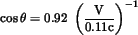 |
(2) |
so = 23 if V = 0.11 c. In view of its sensitivity to V
and the assumption of symmetry, this value of should not be taken too
seriously.
if V = 0.11 c. In view of its sensitivity to V
and the assumption of symmetry, this value of should not be taken too
seriously.
The radio lobes are remarkably round and are quite well separated in the
VLA images (PRM), although joined by a `waist' near the nucleus.
This morphology suggests that is larger than 23.
A larger value
is also suggested by the fact that the hot spots project further away from
the nucleus than the outer edges of the lobes themselves.