


It has long been realised that the outward
motion of hot spots in FRII radio galaxies is sub-relativistic. The most recent
work (Arshakian & Longair 2000) obtains a mean outward velocity
of 0.11c  0.013c. While the velocity of a hot spot in
any individual object is
uncertain, we shall neglect boosting or diminution
of the hot spot fluxes by bulk relativistic motion.
0.013c. While the velocity of a hot spot in
any individual object is
uncertain, we shall neglect boosting or diminution
of the hot spot fluxes by bulk relativistic motion.
The broad-band spectrum (Fig. 8) shows that the X-ray emission
of the western hot spot cannot be synchrotron radiation from a high
energy extension of the population of electrons responsible for the
radio to optical synchrotron radiation. It is, therefore, natural to
consider inverse Compton scattering for the X-ray emission. In the
bright core of the hot spot, the radiant energy density
(
 ) of the synchrotron radiation dominates that of the
microwave background radiation and the galaxy starlight
(Tab. 3), so it is appropriate to consider a synchrotron
self-Compton model
) of the synchrotron radiation dominates that of the
microwave background radiation and the galaxy starlight
(Tab. 3), so it is appropriate to consider a synchrotron
self-Compton model![[*]](/icons/latex2html/footnote.gif) . When the scattering electrons follow a power-law
distribution in
. When the scattering electrons follow a power-law
distribution in  (= E/mc
 ), n() =
n
), n() =
n
 over all , then the inverse Compton
spectrum is a power law with a spectral index
over all , then the inverse Compton
spectrum is a power law with a spectral index
 , the same index as the synchrotron
spectrum. The fact that the radio (
, the same index as the synchrotron
spectrum. The fact that the radio ( =
0.740 0.015) and X-ray (
=
0.740 0.015) and X-ray (
 =
1.07
=
1.07
 ) spectral indices are different then suggests
difficulties with an inverse Compton model. However, in reality, the
electron energy spectrum is a power law over only a certain range of
(from
) spectral indices are different then suggests
difficulties with an inverse Compton model. However, in reality, the
electron energy spectrum is a power law over only a certain range of
(from  to
to  ), and the synchrotron
spectrum is a power law over only a certain range of
), and the synchrotron
spectrum is a power law over only a certain range of  (from
(from
 to
to  ). These limited ranges yield ``end
effects'' in synchrotron self-Compton spectra: the inverse Compton
scattered spectra must turn down below
). These limited ranges yield ``end
effects'' in synchrotron self-Compton spectra: the inverse Compton
scattered spectra must turn down below
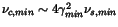 and above
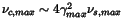 (e.g. Blumenthal & Gould 1970; Rybicki
& Lightman 1979). Further, the synchrotron self-Compton spectrum is
no longer an exact power law between these limits.
(e.g. Blumenthal & Gould 1970; Rybicki
& Lightman 1979). Further, the synchrotron self-Compton spectrum is
no longer an exact power law between these limits.
In order to provide a more realistic evaluation of inverse Compton and
synchrotron self-Compton models, we have performed numerical
calculations of spectra in spherical geometries using the computer
code of Band & Grindlay (1985, 1986), which was kindly provided by
Dan Harris. Given the observed radio - optical spectrum (Fig. 8), we have assumed a power law electron spectrum with  = 2.48
from to . The magnetic field is treated
as a variable. We first computed a synchrotron self-Compton spectrum
which passes through the Chandra-measured flux (model 1). This was
achieved for a magnetic field strength of
= 2.48
from to . The magnetic field is treated
as a variable. We first computed a synchrotron self-Compton spectrum
which passes through the Chandra-measured flux (model 1). This was
achieved for a magnetic field strength of
 gauss, a
factor of 14 below the equipartition field in the radio ``core'' of
the hot spot (Tab. 4). However, the predicted spectrum is
similar to that of the radio source and does not match the measured
X-ray spectrum (Fig. 8).
gauss, a
factor of 14 below the equipartition field in the radio ``core'' of
the hot spot (Tab. 4). However, the predicted spectrum is
similar to that of the radio source and does not match the measured
X-ray spectrum (Fig. 8).
As an alternative to reducing the field strength, the power radiated in
inverse Compton radiation could be increased by increasing the radiation
density. The nucleus of Pictor A might emit a narrow, collimated beam of
radiation (like those inferred to be present in BL Lac objects) along the axis
of the jet. This beam could illuminate the hot spot, but be invisible to us.
However, an (isotropic) nuclear luminosity of 1.6  10
10 erg s
erg s is needed merely to equal the radiant energy density
in synchrotron radiation in the core of the hot spot. The (isotropic)
nuclear luminosity would have to be
is needed merely to equal the radiant energy density
in synchrotron radiation in the core of the hot spot. The (isotropic)
nuclear luminosity would have to be  1.5 10
 erg
s to provide sufficient radiation for the hot spot
to radiate
the observed X-ray flux by inverse Compton scattering if the field has
its equipartition value. This luminosity is unreasonably large.
erg
s to provide sufficient radiation for the hot spot
to radiate
the observed X-ray flux by inverse Compton scattering if the field has
its equipartition value. This luminosity is unreasonably large.
An alternative is that the X-rays are a combination of synchrotron and inverse
Compton radiation.
In model 2, we assumed that the turnover in the synchrotron spectrum
at 10 Hz is an effect of synchrotron losses on a
continuously injected electron spectrum with energy index = 2.48.
The assumed electron spectrum is thus a broken power law (Kardashev 1962):
Hz is an effect of synchrotron losses on a
continuously injected electron spectrum with energy index = 2.48.
The assumed electron spectrum is thus a broken power law (Kardashev 1962):
 |
 |
(3) | |
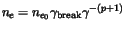 |
 |
(4) |
 = 0.74 well below
the break and = 0.74 + 0.5 = 1.24 is expected well above it
(dotted line in Fig. 8). By adding this spectrum to the
predicted synchrotron self-Compton component for a magnetic field of
= 0.74 well below
the break and = 0.74 + 0.5 = 1.24 is expected well above it
(dotted line in Fig. 8). By adding this spectrum to the
predicted synchrotron self-Compton component for a magnetic field of
 gauss (dot-dashed line in Fig. 8), which is
again well below equipartition, we obtain the solid line in
Fig. 8, which is a good description of the Chandra spectrum.
The parameters of model 2 are given in Tab. 4. Because the
energy density in magnetic field is
gauss (dot-dashed line in Fig. 8), which is
again well below equipartition, we obtain the solid line in
Fig. 8, which is a good description of the Chandra spectrum.
The parameters of model 2 are given in Tab. 4. Because the
energy density in magnetic field is  an order of magnitude
larger than the synchrotron radiation density, the power in the first
order synchrotron self-Compton component is less than that in the
synchrotron radiation (e. g. Rees 1967). Further, the second order
scattered component is even weaker (3 orders of magnitude below the
first order radiation in the Chandra band).
an order of magnitude
larger than the synchrotron radiation density, the power in the first
order synchrotron self-Compton component is less than that in the
synchrotron radiation (e. g. Rees 1967). Further, the second order
scattered component is even weaker (3 orders of magnitude below the
first order radiation in the Chandra band).
Assuming that the electrons are continuously accelerated in the hot
spot, we may interpret the turnover frequency as the frequency at which
the ``half-life'' to synchrotron losses of the radiating electrons is equal
to their
escape time from the hot spot. For the field of
gauss
needed to match the X-ray spectrum, electrons radiating at 10 Hz
have a synchrotron ``half-life'' of 10
Hz
have a synchrotron ``half-life'' of 10 yrs. For a hot spot
radius of 250 pc, the corresponding streaming velocity of the
relativistic electrons is 0.1c.
The
problem with model 2 is the fine tuning needed: synchrotron and
synchrotron self-Compton emission must be present in the Chandra band
with comparable fluxes.
yrs. For a hot spot
radius of 250 pc, the corresponding streaming velocity of the
relativistic electrons is 0.1c.
The
problem with model 2 is the fine tuning needed: synchrotron and
synchrotron self-Compton emission must be present in the Chandra band
with comparable fluxes.
Inverse Compton and Synchrotron Emission from Hypothetical New Electron Populations
In the previous subsection, we showed that the X-ray emission is so
strong that the magnetic field in the hot spot must be a factor of
 14 below equipartition if the X-rays are produced by inverse
Compton scattering from the electrons that generate the observed
radio emission. Even then, the observed X-ray spectrum is different
to the predicted one (Fig. 8), and so this model (model 1,
Tab. 4) may be ruled out. The other process capable of
generating the observed X-rays is synchrotron radiation. However, the
X-ray emission of the hot spot is not a smooth continuation of the
radio - optical synchrotron spectrum. In model 2, we contrived to fit
the X-ray spectrum by a combination of synchrotron emission from an
extension of the radio-optical spectrum and synchrotron self-Compton
from the radio-optical synchrotron-emitting electrons. In view of the
unsatisfactory nature of these models, we now consider inverse Compton
and synchrotron models involving hypothetical new electron
populations.
14 below equipartition if the X-rays are produced by inverse
Compton scattering from the electrons that generate the observed
radio emission. Even then, the observed X-ray spectrum is different
to the predicted one (Fig. 8), and so this model (model 1,
Tab. 4) may be ruled out. The other process capable of
generating the observed X-rays is synchrotron radiation. However, the
X-ray emission of the hot spot is not a smooth continuation of the
radio - optical synchrotron spectrum. In model 2, we contrived to fit
the X-ray spectrum by a combination of synchrotron emission from an
extension of the radio-optical spectrum and synchrotron self-Compton
from the radio-optical synchrotron-emitting electrons. In view of the
unsatisfactory nature of these models, we now consider inverse Compton
and synchrotron models involving hypothetical new electron
populations.
i) X-rays as inverse Compton radiation
For a successful inverse Compton scattering model, a low energy
population of relativistic electrons with an index of the energy
spectrum p 2 + 1 is needed. The required value of
p is thus p
+ 1 is needed. The required value of
p is thus p 3.14
3.14
 . Fig. 9 shows a model (model 3, Tab. 4) for the hot spot in which
a synchrotron-emitting component with a larger spectral index than
that observed in the radio has been added at low radio
frequencies. The spectrum of the hot spot has not been measured below
327 MHz, but the extension of this hypothetical spectrum down to lower
frequencies does not exceed the measured integrated flux density
of Pictor A (the lowest such measurements are at 80 MHz, see
PRM). It is envisaged that the population of electrons which emits
the observed synchrotron radio emission is in a relatively
strong (e.g. equipartition, Tab. 3) magnetic field, so that
the synchrotron self- Compton emission from this electron
population is negligible, as shown above. However, the observed
radio-optical synchrotron radiation, as well as the radio
synchrotron radiation of the hypothesised component, is available for
scattering by the hypothetical low energy electron population. As can
be seen from Fig. 9, the low energy electrons must radiate
predominantly through the inverse Compton channel, requiring a very
weak magnetic field (model 3, Tab. 4) which is 100
times weaker than the equipartition field in the core of the western
hot spot. The calculation shows that the second order Compton
scattered component is 2 orders of magnitude weaker than the
first order Compton scattered component in the Chandra band. We find
that the spectrum of the low energy electrons has to be steep (p =
3.3) as shallower spectra (p
. Fig. 9 shows a model (model 3, Tab. 4) for the hot spot in which
a synchrotron-emitting component with a larger spectral index than
that observed in the radio has been added at low radio
frequencies. The spectrum of the hot spot has not been measured below
327 MHz, but the extension of this hypothetical spectrum down to lower
frequencies does not exceed the measured integrated flux density
of Pictor A (the lowest such measurements are at 80 MHz, see
PRM). It is envisaged that the population of electrons which emits
the observed synchrotron radio emission is in a relatively
strong (e.g. equipartition, Tab. 3) magnetic field, so that
the synchrotron self- Compton emission from this electron
population is negligible, as shown above. However, the observed
radio-optical synchrotron radiation, as well as the radio
synchrotron radiation of the hypothesised component, is available for
scattering by the hypothetical low energy electron population. As can
be seen from Fig. 9, the low energy electrons must radiate
predominantly through the inverse Compton channel, requiring a very
weak magnetic field (model 3, Tab. 4) which is 100
times weaker than the equipartition field in the core of the western
hot spot. The calculation shows that the second order Compton
scattered component is 2 orders of magnitude weaker than the
first order Compton scattered component in the Chandra band. We find
that the spectrum of the low energy electrons has to be steep (p =
3.3) as shallower spectra (p  3.3) cause the inverse Compton
spectrum to increase above
3.3) cause the inverse Compton
spectrum to increase above  Hz, contrary to our X-ray
observations. Taking this model to its extreme, the hypothetical
electron population could be in a region free of magnetic field, and
thus radiate no radio emission at all. This requirement for a weak or
absent magnetic field associated with this population is difficult to
understand in view of the finding that the X-ray, optical and radio
emitting regions of the western hot spot are co-spatial (Section 3.2.1
and Fig. 3). High resolution radio observations at lower
frequencies would provide stronger constraints on this model.
Hz, contrary to our X-ray
observations. Taking this model to its extreme, the hypothetical
electron population could be in a region free of magnetic field, and
thus radiate no radio emission at all. This requirement for a weak or
absent magnetic field associated with this population is difficult to
understand in view of the finding that the X-ray, optical and radio
emitting regions of the western hot spot are co-spatial (Section 3.2.1
and Fig. 3). High resolution radio observations at lower
frequencies would provide stronger constraints on this model.
ii) X-rays as synchrotron radiation
Alternatively, the X-ray emission of the hot spot could be synchrotron
radiation from a separate population of electrons. In such models
(models 4a and b), the energy index of the X-ray emitting electrons
would be p 3.14
, similar to
the above inverse Compton model. In view of the short synchrotron loss
times (a few years for a 5 keV-emitting electron in the equipartition
field), the energy index at injection would be p
 2.14
in a steady state, continuous
injection model. The synchrotron break frequency must thus be below
the X-ray band but above 10
2.14
in a steady state, continuous
injection model. The synchrotron break frequency must thus be below
the X-ray band but above 10 Hz (otherwise the emission would
exceed the observed flux at the latter frequency). Models 4b and 4a
(Tab. 4), in which we have adopted the equipartition field,
represent these two extremes for the synchrotron break frequency,
respectively. Thus, in both these models, the extrapolation of the
X-ray spectrum to lower frequencies does not exceed the observed
radio, infrared or optical flux. Interestingly, the required value of
p
is the same to within the errors as the canonical
index for particle acceleration by a strong shock (p = 2, e.g. Bell
1978; Blandford & Ostriker 1978). In this picture, electrons would
have to be continuously reaccelerated by such shocks on pc scales.
Hz (otherwise the emission would
exceed the observed flux at the latter frequency). Models 4b and 4a
(Tab. 4), in which we have adopted the equipartition field,
represent these two extremes for the synchrotron break frequency,
respectively. Thus, in both these models, the extrapolation of the
X-ray spectrum to lower frequencies does not exceed the observed
radio, infrared or optical flux. Interestingly, the required value of
p
is the same to within the errors as the canonical
index for particle acceleration by a strong shock (p = 2, e.g. Bell
1978; Blandford & Ostriker 1978). In this picture, electrons would
have to be continuously reaccelerated by such shocks on pc scales.