


Some estimated parameters of the jet are given in Tab. 5. It
is apparent that the microwave background radiation dominates the
radiant energy within the jet, unless the radius of the radio
synchrotron-emitting region is much smaller than the observed radius
of the X-ray jet. The X-rays from the jet could be either inverse
Compton or synchrotron radiation, which we discuss in turn. Evaluation
of these models is limited by our ignorance of the jet's radio
spectrum. For concreteness, we shall adopt a jet radius of
1
 (950 pc) for both the radio and X-ray emission.
i) X-rays as inverse Compton radiation
Adopting
 = 0.87, S
 = 152 mJy
for the part of the jet detected in X-rays (Section
4.3.1), and the equipartition field H
= 152 mJy
for the part of the jet detected in X-rays (Section
4.3.1), and the equipartition field H =
2.3
=
2.3  10
10 gauss,
the predicted inverse Compton scattered X-ray flux falls a factor of
gauss,
the predicted inverse Compton scattered X-ray flux falls a factor of
 500 below
that observed. In order to match the observed X-ray flux, we need to
reduce the magnetic
field to H 7 10
500 below
that observed. In order to match the observed X-ray flux, we need to
reduce the magnetic
field to H 7 10 gauss,
a factor of 30 below equipartition.
Alternatively, as for the hot spot,
we could invoke a radiation beam from the nucleus to boost the radiation
density in the jet. To obtain the observed X-ray flux from the jet while
retaining the equipartition field requires an (isotropic) nuclear
luminosity of
gauss,
a factor of 30 below equipartition.
Alternatively, as for the hot spot,
we could invoke a radiation beam from the nucleus to boost the radiation
density in the jet. To obtain the observed X-ray flux from the jet while
retaining the equipartition field requires an (isotropic) nuclear
luminosity of  2 10
2 10 erg s
erg s , which is
implausibly high. We could also suppose, as we did for the hot spot,
that the observed radio jet contains a stronger
(e.g. equipartition) magnetic field and there is, in addition, a
population of electrons in a weak or absent field. Because we do not
know the radio spectrum of the jet, and have thus not been able to
demonstrate that the radio and X-ray spectral indices are
different, we cannot prove that the radio- and X-ray-emitting electrons
represent different populations,
as we could for the hot spot.
, which is
implausibly high. We could also suppose, as we did for the hot spot,
that the observed radio jet contains a stronger
(e.g. equipartition) magnetic field and there is, in addition, a
population of electrons in a weak or absent field. Because we do not
know the radio spectrum of the jet, and have thus not been able to
demonstrate that the radio and X-ray spectral indices are
different, we cannot prove that the radio- and X-ray-emitting electrons
represent different populations,
as we could for the hot spot.
The above discussion neglects relativistic boosting or diminution by possible
bulk relativistic motion of the jet. There is now a strong case for energy
transport at bulk relativistic velocities to the hot spots in FRII
sources (e.g. Bridle 1996). For emission which is isotropic in the
rest frame and has a power law spectrum, the observed flux density,
 ,
is
related to the flux density in the rest frame,
,
is
related to the flux density in the rest frame,
 , by
, by
 |
(5) |
where
![$\delta = [\Gamma(1\ - \beta\ \cos\theta)]^{-1}$](img116.gif) ,
,
 is the Lorentz factor of the bulk flow,
  is the
bulk velocity in units of the speed of light, and
is the
bulk velocity in units of the speed of light, and  is
the angle between the velocity vector and the line of sight
(e.g. Urry & Padovani
1995). This equation assumes that the emission comes from a discrete,
moving source. For a smooth, continuous jet, the exponent 3+
is
the angle between the velocity vector and the line of sight
(e.g. Urry & Padovani
1995). This equation assumes that the emission comes from a discrete,
moving source. For a smooth, continuous jet, the exponent 3+ becomes
2+ (Begelman, Blandford & Rees 1984). Equation (5) will describe
relativistic boosting or diminution of the jet's synchrotron radiation, as long
as that radiation is isotropic in the jet's rest frame.
becomes
2+ (Begelman, Blandford & Rees 1984). Equation (5) will describe
relativistic boosting or diminution of the jet's synchrotron radiation, as long
as that radiation is isotropic in the jet's rest frame.
As noted above (Tab. 5), the radiation density in the jet is
dominated by the microwave background radiation, which is isotropic in
the observer's frame and anisotropic in the rest frame of the jet. In
this case, the principal dependence of the inverse Compton scattered
radiation on is given by (Dermer 1995)
 |
(6) |
where an additional term which depends slowly on  has been
omitted (Begelman & Sikora 1987; Dermer 1995). Retaining the discrete
source model, the ratio of inverse Compton scattered to synchrotron
flux is then
has been
omitted (Begelman & Sikora 1987; Dermer 1995). Retaining the discrete
source model, the ratio of inverse Compton scattered to synchrotron
flux is then
 |
(7) |
The orientation of the jet in Pictor A w.r.t. the line of sight is unknown.
However,
various considerations (Section 4.1) indicate that is at least
23 and probably larger. For this value of , the maximum
possible value of
and probably larger. For this value of , the maximum
possible value of
 is 5.8 (achieved at 2.6), and
this number is smaller for larger . We conclude that the factor
of 500
discrepancy between the predicted and observed inverse Compton X-rays
for an equipartition field cannot be resolved by differential relativistic
boosting.
is 5.8 (achieved at 2.6), and
this number is smaller for larger . We conclude that the factor
of 500
discrepancy between the predicted and observed inverse Compton X-rays
for an equipartition field cannot be resolved by differential relativistic
boosting.
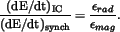
The following simple fact argues against inverse Compton scattering for the jet's X-ray emission: in the radio band, the western lobe dominates the jet, while in X-rays the converse is true. The ratio of the rates of energy loss to inverse Compton scattering and synchrotron radiation is
 |
(8) |
The radiant energy density in both the jet and western lobe is
dominated by the microwave background radiation. The equipartition
magnetic field in the jet is 2.3 10 gauss
(for r = 1
, see Tab. 5) and that
in the lobe is 5 10
= 1
, see Tab. 5) and that
in the lobe is 5 10 gauss. Thus one expects
that the ratio (dE/dt)
gauss. Thus one expects
that the ratio (dE/dt) /(dE/dt)
 should be
larger for the lobe than the jet. Given that the lobe's radio
synchrotron radiation overwhelmingly dominates that of the jet, the
lobe's inverse Compton emission should dominate the jet by an even
larger factor, contrary to observation. However, the jet's inverse
Compton emission would be larger if either a) its magnetic field is
well below equipartition, or b) a narrow beam of radiation is emitted
by the nucleus along the jet, providing a larger
should be
larger for the lobe than the jet. Given that the lobe's radio
synchrotron radiation overwhelmingly dominates that of the jet, the
lobe's inverse Compton emission should dominate the jet by an even
larger factor, contrary to observation. However, the jet's inverse
Compton emission would be larger if either a) its magnetic field is
well below equipartition, or b) a narrow beam of radiation is emitted
by the nucleus along the jet, providing a larger
 than
the microwave background, as discussed above. Both of these
possibilities are ad hoc and so we consider the prominence of
the jet compared to the lobe in the Chandra image as an argument
against inverse Compton scattering.
than
the microwave background, as discussed above. Both of these
possibilities are ad hoc and so we consider the prominence of
the jet compared to the lobe in the Chandra image as an argument
against inverse Compton scattering.
ii) X-rays as synchrotron radiation
As already noted, the available data are consistent with a single power
law with
 = 0.87 from 1.4 GHz to 10 keV. This is,
however, an unlikely physical situation for a purely synchrotron spectrum
in view of the short energy loss times of the X-ray emitting
electrons to synchrotron and inverse Compton radiation. For electrons
emitting synchrotron radiation at 1.4 GHz and 1 keV in the equipartition
field of 2.3 10 gauss, the times to lose half their energy
are 4 10
= 0.87 from 1.4 GHz to 10 keV. This is,
however, an unlikely physical situation for a purely synchrotron spectrum
in view of the short energy loss times of the X-ray emitting
electrons to synchrotron and inverse Compton radiation. For electrons
emitting synchrotron radiation at 1.4 GHz and 1 keV in the equipartition
field of 2.3 10 gauss, the times to lose half their energy
are 4 10 and 300 yrs, respectively. If the energies of
the radio-emitting electrons are not significantly reduced by synchrotron and
inverse Compton losses, we would expect the radio spectrum to be flatter
than the X-ray spectrum; in the simplest case involving continuous
injection,
=
and 300 yrs, respectively. If the energies of
the radio-emitting electrons are not significantly reduced by synchrotron and
inverse Compton losses, we would expect the radio spectrum to be flatter
than the X-ray spectrum; in the simplest case involving continuous
injection,
=
 - 0.5 0.4.
It would thus be valuable to measure
.
- 0.5 0.4.
It would thus be valuable to measure
.
For a synchrotron model in which the electrons are isotropic in the frame of bulk jet motion, the observed ratio of flux in the approaching side of the jet to the receding side is given by
 |
(9) |
From X-ray observations
 and
and  at the brightest part of the X-ray jet.
Assuming
at the brightest part of the X-ray jet.
Assuming  23 (section 4.1), then 0.3.
This is approximately three times larger than the
inferred average recessional speed of hot spots from the nucleus.
If the X-rays are the result of inverse Compton scattering of the
microwave background radiation, the exponent 3+ in equation (9)
becomes 4+2 (cf. equation 6) and a somewhat smaller lower limit to
is obtained.
23 (section 4.1), then 0.3.
This is approximately three times larger than the
inferred average recessional speed of hot spots from the nucleus.
If the X-rays are the result of inverse Compton scattering of the
microwave background radiation, the exponent 3+ in equation (9)
becomes 4+2 (cf. equation 6) and a somewhat smaller lower limit to
is obtained.