January 23, 2026 8-10 PM
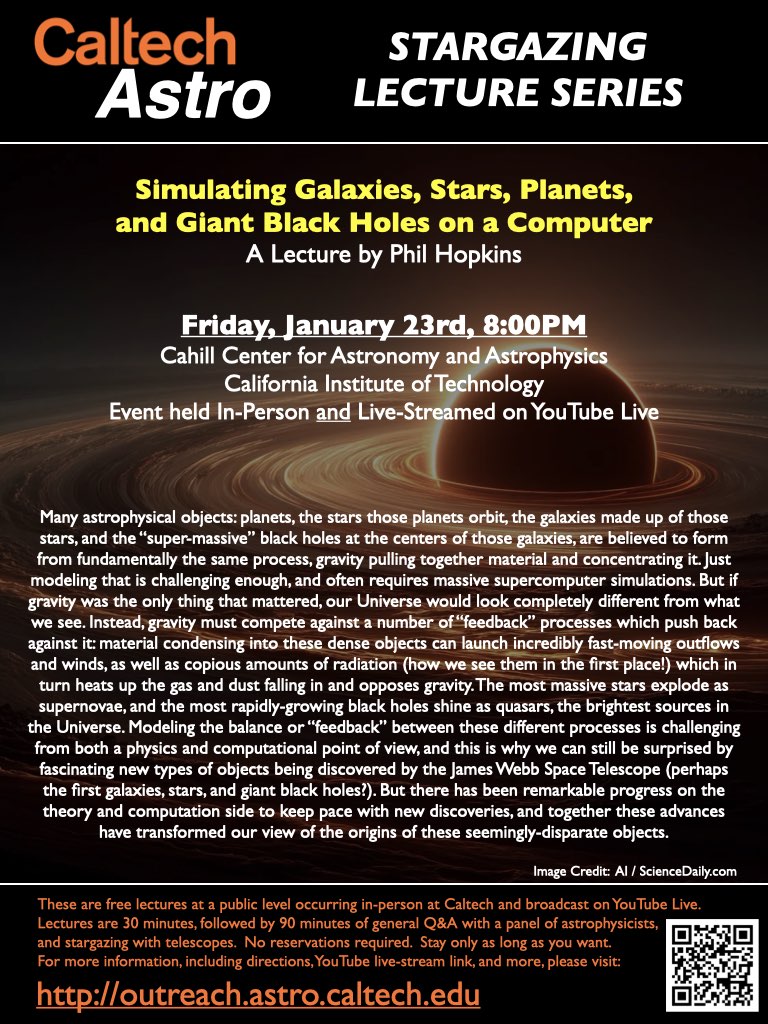
Event Type: Lecture and StargazingTitle: Simulating Galaxies, Stars, Planets, and Giant Black Holes on a Computer
Lecturer: Phil Hopkins
Position: Professor
Institution: Caltech
Abstract:
Many astrophysical objects: planets, the stars those planets orbit, the galaxies made up of those stars, and the “super-massive” black holes at the centers of those galaxies, are believed to form from fundamentally the same process, gravity pulling together material and concentrating it. Just modeling that is challenging enough, and often requires massive supercomputer simulations. But if gravity was the only thing that mattered, our Universe would look completely different from what we see. Instead, gravity must compete against a number of “feedback” processes which push back against it: material condensing into these dense objects can launch incredibly fast-moving outflows and winds, as well as copious amounts of radiation (how we see them in the first place!) which in turn heats up the gas and dust falling in and opposes gravity. The most massive stars explode as supernovae, and the most rapidly-growing black holes shine as quasars, the brightest sources in the Universe. Modeling the balance or “feedback” between these different processes is challenging from both a physics and computational point of view, and this is why we can still be surprised by fascinating new types of objects being discovered by the James Webb Space Telescope (perhaps the first galaxies, stars, and giant black holes?). But there has been remarkable progress on the theory and computation side to keep pace with new discoveries, and together these advances have transformed our view of the origins of these seemingly-disparate objects.


| I | Attachment | History | Action | Size | Date | Who | Comment |
|---|---|---|---|---|---|---|---|
 jpg jpg |
20260123V.jpg | r1 | manage | 236.2 K | 2026-01-15 - 19:21 | OutreachAdmin |
 Edit | Attach |
 Topic revision: r1 - 2026-01-15 - OutreachAdmin


 Site map
 Main web

 Users
Users Groups
 Index
Index Search
 Changes
 Notifications
 RSS Feed
 Statistics
 Preferences





 Copyright © 2008-2026 by the contributing authors. All material on this collaboration platform is the property of the contributing authors.
 Ideas, requests, problems regarding TWiki? Send feedback