|
1
|
|
|
2
|
|
|
3
|
|
|
4
|
|
|
5
|
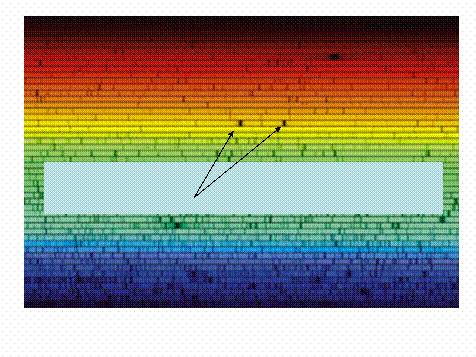
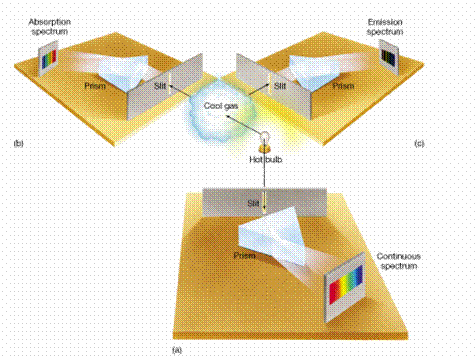
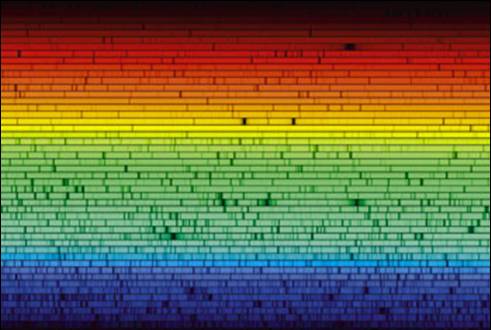
- Relate continuous spectra, emission line spectra, &
- absorption
line spectra
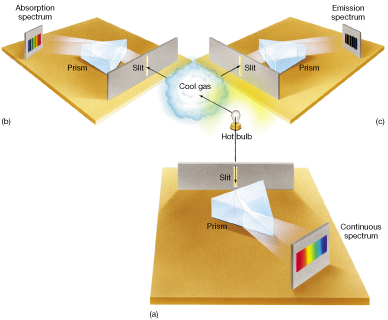
- Hot opaque solid (dense gas) emits light of all wavelengths ® continuous spectrum of
radiation
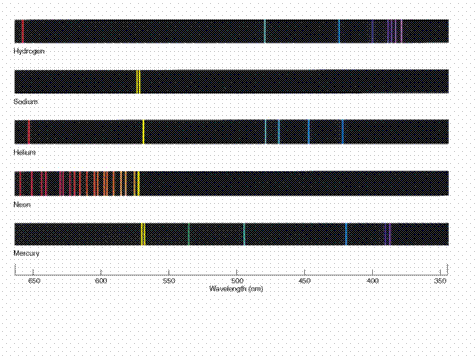
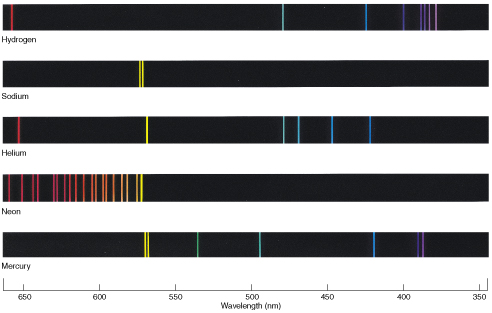
- Low density (transparent) hot gas emits spectrum of bright emission
lines
- Low density (transparent) cool gas in front of a blackbody absorbs wavelengths from
the continuous spectrum ® dark absorption line
spectrum on continuous spectrum (wavelengths same as emission lines from
hot gas)
- Spectroscopy enables determinations of chemical structure of stars
|
|
6
|
|
|
7
|
|
|
8
|
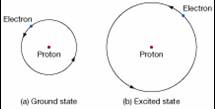
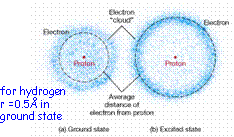
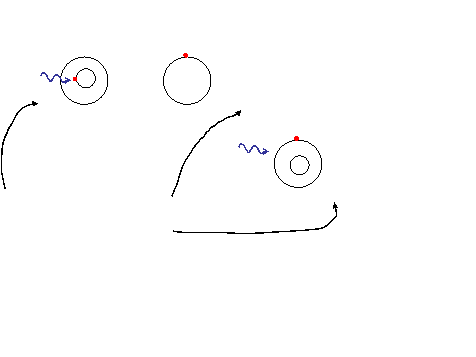
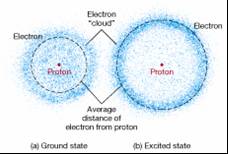
- Quantum transitions
- energy levels within atomic and
molecular systems quantized
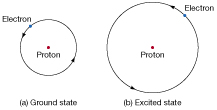
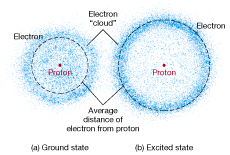
- only discrete orbits/energies
permitted
- when atom makes a transition between 2 states, gives up energy corresponding to the
difference
- discrete amounts of energy only (photons)
- DE = Efinal - Einitial = hn (h = Planck’s constant, 6.6 x 10⁻²⁷
erg sec)
- types of transition
- collisional excitation/de-excitation
DE = ½mv2
- radiative absorption +
spontaneous emission; stimulated emission
- photon energy µ radiation frequency
(color)
- DE = hn = hc/l
- e.g. for l = 7000Å, Ephoton ~ 2 eV (1eV = 1.6 x 10⁻¹²
ergs)
- - very low energy
|
|
9
|
|
|
10
|
|
|
11
|
|
|
12
|
|
|
13
|
|
|
14
|
- Continuous spectrum B-B radiation ® T*
- Spectral classification ® T*
- tightly bound atoms (e.g. H and He) can survive to 20,000K
- weakly bound atoms are ionized
above ~ 8000K
- molecules survive only up to
~3000K
- e.g. if O, Ca, Mg lines observed, but no
molecules
- T ~ 5000-8000K
|
|
15
|
- Recall Lµ R2
x T4 – knowing L, T ® R
- For Mira, L = 400 L¤ (L¤ = 3.8 x 1033 ergs/sec)
- T= 2700K = 0.5T¤ (T¤ = 5800K)
- so, R = 20/0.25 = 80 R¤ (R¤ =6.9 x 10¹⁰
cm
- For Sirius B, L = 0.04 L¤
- T= 23,200K = 4T¤
- so, R = 0.2/16 = 0.01 R¤
|
|
16
|
|
|
17
|
|
|
18
|
|
|
19
|
|
|
20
|
|
|
21
|
|

 Notes
Notes