|
1
|
|
|
2
|
|
|
3
|
- Young’s experiment ®
wave nature
- l = wavelength =
length between crests/valleys
- n = frequency = number
of crests passing per unit time
- = cycles
per sec (Hz) = 1/P
- P = period = time for wave to repeat itself
- nl = c (speed of light - celeritas) = 3 x 10¹⁰
cm/sec
- = 300, 000 km/s
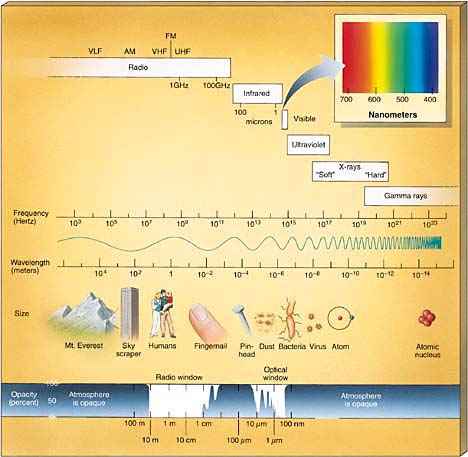
- visible light: 4000 < l > 8000 Ångstrom (1Å =
10-8 cm)
- For a star, let B= brightness = power/area = power/4pd2
- If L = total output of star, L = Bx4pd2
and B = L/4pd2
|
|
4
|
- charged particles (electrons, protons) and carry electric field,
strength of field µ 1/d2
- collision or heating ®
particle vibration ® change in field ® change in electrical forces on other particles
- change in electrical forces ® information about original particle
- ®information
transmitted through a disturbance (change in electrical field)
- magnetic field associated with electrical field
- ®electromagnetic
waves
- Electromagnetic waves from moving charged particles
- in astronomical objects
- propagate at speed of light, c (need not be visible)
|
|
5
|
|
|
6
|
- Thermal radiation
- constituent particles in constant random motion ® e-m radiation
- temperature @
amount of motion
- radiation emitted over range of frequencies
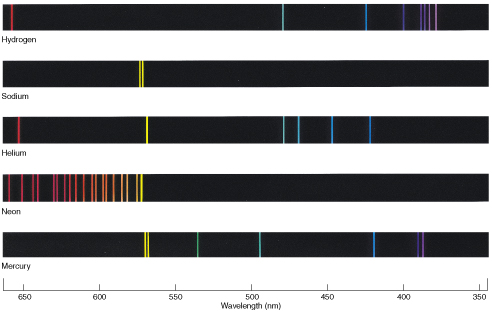
- Spectral line radiation
- discrete quantum mechanical line radiation -- only at n corresponding to quantized
energy level differences
|
|
7
|
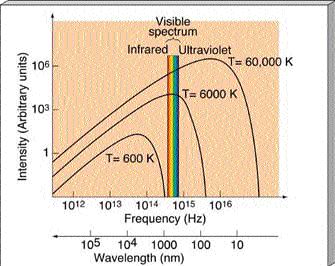
- Blackbody absorbs (& re-emits) all energy falling onto it
- characteristic of any opaque surface (e.g. stove burner
- depends only on T of surface (not shape or composition)
- Kirkoff’s Law : perfect absorber = perfect emitter = Blackbody
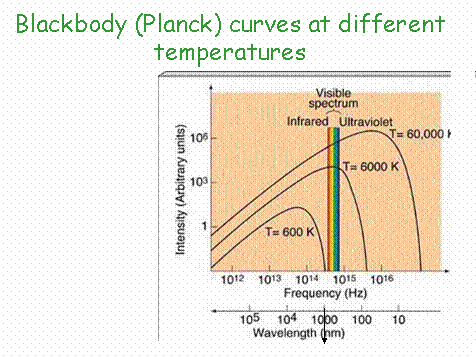
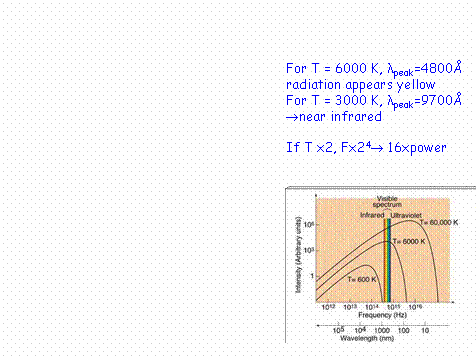
- Intensity of radiation versus frequency ® blackbody curve
|
|
8
|
|
|
9
|
- Wien’s law :
- lpeak = 0.289 / T(K) cm
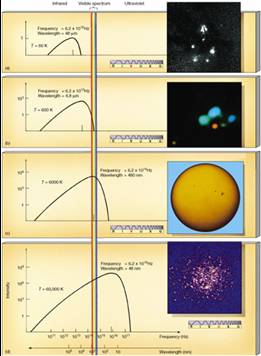
- lpeak ® color: hotter ® bluer (shorter l)
- cooler ® redder (longer l)
- Greater total energy (summed over all wavelengths) radiated by hotter
objects
- ¯
- Stefan’s Law :
- energy radiated/unit area of B-B surface/unit time µ (temp)4
- F = sT4
- Flux = 5.67x 10⁻⁸T4
watt/m2/K4
- Stefan’s constant = s
|
|
10
|
|
|
11
|
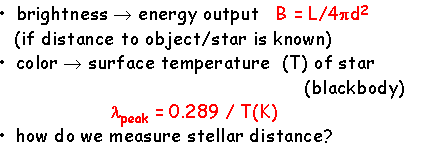
- brightness ® energy
output B = L/4pd2
- (if distance to object/star is
known)
- color ® surface
temperature (T) of star
-
(blackbody)
- lpeak = 0.289 / T(K)
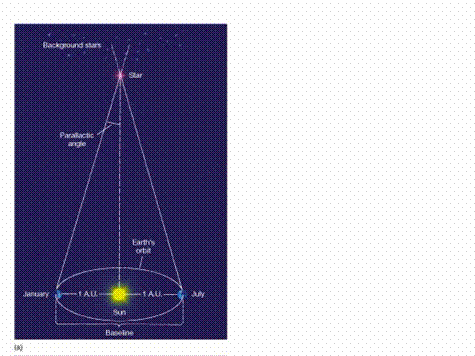
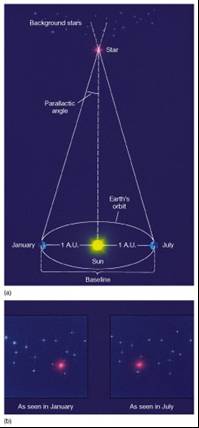
- how do we measure stellar distance?
|
|
12
|
|
|
13
|
|
|
14
|
|
|
15
|
|
|
16
|
|
|
17
|
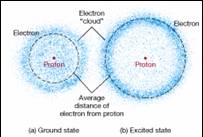
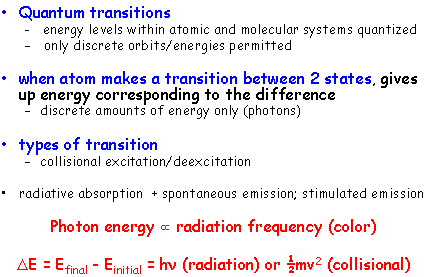
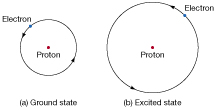
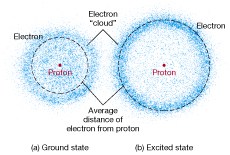
- Quantum transitions
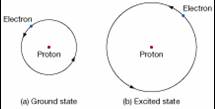
- energy levels within atomic and
molecular systems quantized
- only discrete orbits/energies
permitted
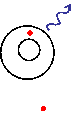
- when atom makes a transition between 2 states, gives up energy corresponding to the
difference
- discrete amounts of energy only (photons)
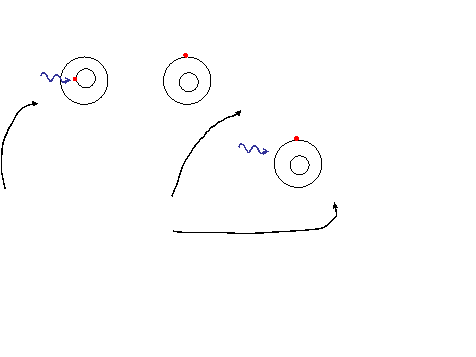
- types of transition
- collisional excitation/deexcitation
- radiative absorption +
spontaneous emission; stimulated emission
- Photon energy µ
radiation frequency (color)
- DE = Efinal
- Einitial = hn (radiation) or ½mv2 (collisional)
|
|
18
|
|
|
19
|
|
|
20
|
|
|
21
|
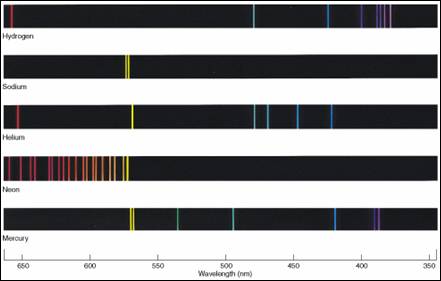
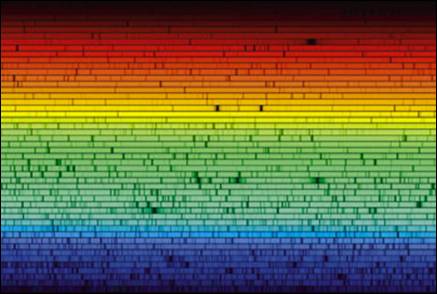
- Relate continuous spectra, emission line spectra, &
- absorption
line spectra
- Luminous solid (dense gas) emits light of all wavelengths ® continuous spectrum of
radiation
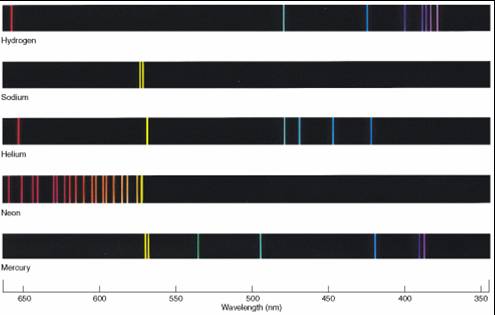
- Low density hot gas emits spectrum of bright emission lines ® composition of gas
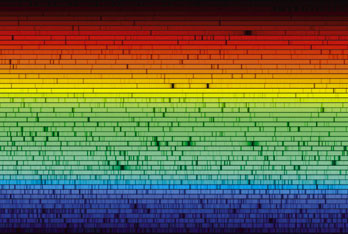
- Low density cool gas absorbs wavelengths from continuous spectrum ® dark absorption lines on
continuous spectrum (wavelengths same as emission lines from hot gas)
|
|
22
|
|

 Notes
Notes