FEPS PROGRAM STELLAR AGES
Original: 5 April 2005
Last Revised: 14 Sept 2007
Lynne Hillenbrand


For discussion by the "core" FEPS ages group:  Hillenbrand, Mamajek, Stauffer, Soderblom, Meyer, Carpenter (as well as anyone else who can substantially participate --  make yourselves known!!)


Our motto:  "The determination of ages for individual field stars.....is a field with rich opportunities for large systematic as well as random errors"  (Holmberg et al. 2007)


Skip to:

......Goals ......
......Project Status ...... 
......Procedure to realize an age ...... 
......Database issues
......
......Age estimators ......

......Assigning final ages......


Goals:


Status:

after a two-year hiatus, the ages group is back in action!

link
to current paper figures [not updated since 2005]

link to ages derived from various techniques [not updated since 2005]
figure illustrating age vs age correlations. ACTION: assess offsets and correlations with color; improve the various age calibrations

link to ages for "IRAC paper" targets
link to ages for "first-look" gas targets


Procedure to Realize an Age:
plot of dispersions in database for EWLI, log-g, Fe/H, R'HK, vsini, vrad


Database issues:

Status:  
Data actions:  

Estimators of stellar age:


membership in an open cluster
Relevant # of FEPS stars:  ~130
                                             22 - Hyads,  20 - Pleaids,  13-  Alpha Per,  5 - IC 2602,  
                                             14 - LCC,  23 - UCL,  17 USco,  7 Cor Aust

Status:


Data actions:


Analysis actions:

General Concerns:

hrd isochrones

Relevant # of FEPS stars: ~90 Pre MS,  ~240  MS, and 2 bona fide Post MS

Status:

                                log(age/yr)   age(Myr) 
                      LCC                           17
                      IC 2391   ~7.71          52                
                      Pleiades  ~8.01         102       
                       figure illustrating post-main sequence tracks                                                                                                   Data actions:  
           

Analysis actions:


           I have a program that makes monte carlo realizations of HRD positions,    
           interpolates their ages and masses from tracks, and then quantifies the
           mean, median, and confidence intervals (use 68%?) for the ages and masses. 
General Concerns:


rotation (vsini and period)

Relevant # of FEPS stars: ~300 stars with vsini values, though 40 are upper limits.  
                                             101 stars with periods !!

Status:
Data actions:

Analysis actions:


General Concerns:


xray luminosity

Relevant # of FEPS stars: 271 from a large and relatively homogeneous database: ROSAT


Status:

Data actions:

Analysis actions:


General Concerns:

                             
CaII HK       
               
Relevant # of FEPS stars:   258 stars!                                  

Status:
Data actions:
Analysis actions:
General Concerns:

 LiI 6708
Relevant # of FEPS stars:  ~315!

Status:
Data actions:

Analysis actions:
General Concerns: 

                              
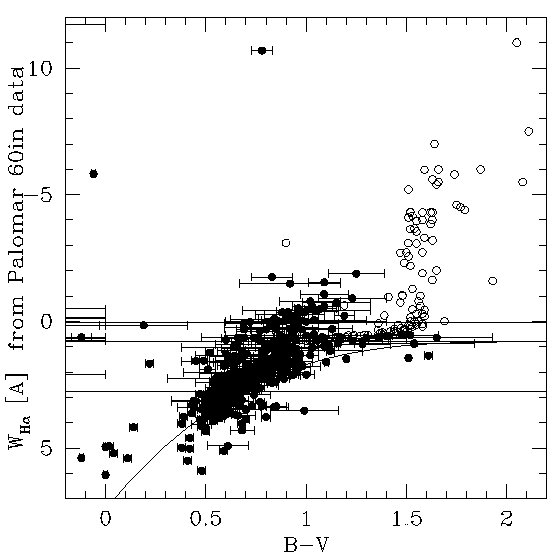
HI alpha
Relevant # of FEPS stars:  ~230
                                            main reference is P60 data since we have not tabulated this quantity from the literature.

Status:
Data actions:

Analysis actions:


General Concerns:
                          
uv continuum/line
Relevant # of FEPS stars: none at present

Status:
Data actions:

Analysis actions:

General Concerns:


kinematics
Relevant # of FEPS stars:  now 286 stars with radial velocities!

Status:
                                 - 1) ALL FEPS SOURCES SHOULD BE DEMONSTRLY "YOUNG DISK" STARS
                                 - 2) KINEMATICS ALSO USED TO CONSTRAIN MEMBERSHIP IN MOVING GROUPS
                                 - 3) KINEMATIC DISTANCES FEEDS INTO HRD
Data actions:
Analysis actions:

I still need to calculate a few more group space motions
(for T associations with no published UVWs) before calculating "final"
membership probabilities for FEPS targets. I'm also trying to figure out
if/how to weight membership probabilities (what do you do when you have
a star that has a high membership probability to several groups? is a high
membership probability even useful at that point?).

             General Concerns:


Assigning Final Ages:

[the diagnostic information from this section has been updated and moved
here ]

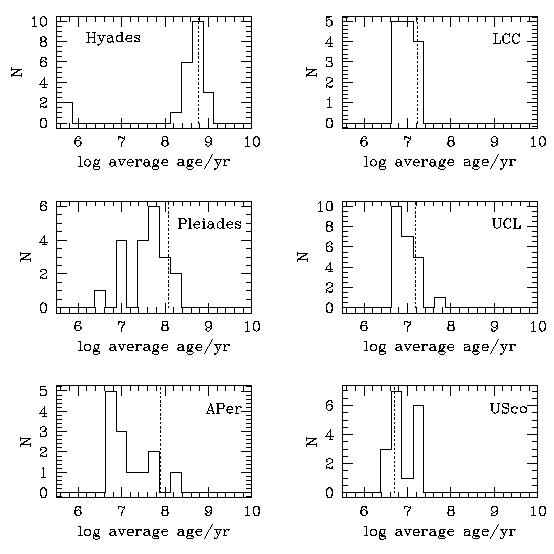
  • figure showing how well we would do by adopting the "average" ages for the cluster stars. this is surprisingly good at young ages and disturbingly bad at slightly older ages

  • need to make figure illustrating our ages compared to HRD assigned ages, say from Valenti/Fischer 2005 or Holmberg et al. 2007
  • Here is a sanity check.  This list (generated by Nathan Crockett) shows stars that were
    marked as being younger than 300 Myr and also metal poor (say <-0.8; this
    is in reference to Figure 5 of the rough draft that Joan sent out). 

    Name              [Fe/H] from VF05
    ========== =========
    BD+51_1696 -1.48
    HD_134440 -1.41
    HD_134439 -1.48
    HD_230409 -0.86
    HD_188510 -1.64
    HD_193901 -1.23

  • Stauffer suggested procedure (LAH edited text):  Our immediate goal is to identify a path to assigning ages that we can reasonably implement and complete within the next few months with plausible level of effort from the ages group.

    Organization: below is a pathway to follow in assigning ages. More or less, the idea is to assign stars to one of several bins, and derive their age according to the bin they fall into. This may or may not address all of our stars - the idea would be to work through the proposed process, and see if all the stars are covered or not. If not, the process can be amended. The description below is schematic, and still needs to have each method "definitized" (e.g. whose Rhk' age relation, or derive our own).

    1) Use an agreed upon relation between CaHK normalized flux and age if have CaHK data and if: - vsini < 15 km/s - displacement above MS is either < 0.5 mag or unknown - not in a cluster or in an EEM moving group - Rhk' < -4.4 (all criteria to exclude stars that are too young for this method)    These criteria are intended to be both practical in the sense of keeping us in regimes where the data are good, and scientifically robust in the sense of keeping us away from activity saturation effects.

    2) Age from cluster or from an EEM approved moving group

    3) If have a distance, and if the displacement above the MS > 0.9 mag, then use isochrone age if not in (2).

    4) If neither (1) or (2), and have lithium data, derive lithium age from EEM algorithm. If also have age from (3), use average. If lithium age is contradicted by (3), only use (3). If lithium age implies a displacement above the MS > 0.5 mag and that is not true, do not use lithium age.

    5) If neither (1) or (2), and have Lx/Lbol, derive xray age from a to-be-derived EEM algorithm (a la his lithium algorithm), using xray data for open clusters from Sofia Randich papers and also xray data from Sco Cen. If ages from (3) and (4) are also available, derive an average. If the age from Lx is contradicted by (3), do not use the xray age. If the xray age implies a displacement above the MS > 0.5 mag and that is not true, do not use the xray age.    Possible to combine coronal and chromospheric indicators, i.e. merge #1 and #5.


  • Mamajek suggested procedure: use medians of applicable ages.