


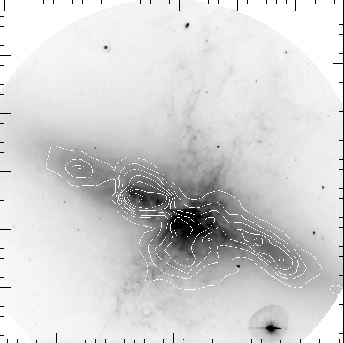
 image with
the UV image observed in the 2490Å band by the UIT. The
southern outflow is clearly evident in ultraviolet emission, out to at
least a kiloparsec. The northern outflow is only barely visible in
the UIT data, presumably because of the high disk extinction
at ultraviolet wavelengths. The projected morphology of the southern
UV outflow is similar to that at H wavelengths, consisting of a
relatively smooth, broad fan of emission. The ratio of the H and
UV surface brightnesses (each in units of ergs s-1 cm-2
arcsec-2 Å-1) in the outflow region is
image with
the UV image observed in the 2490Å band by the UIT. The
southern outflow is clearly evident in ultraviolet emission, out to at
least a kiloparsec. The northern outflow is only barely visible in
the UIT data, presumably because of the high disk extinction
at ultraviolet wavelengths. The projected morphology of the southern
UV outflow is similar to that at H wavelengths, consisting of a
relatively smooth, broad fan of emission. The ratio of the H and
UV surface brightnesses (each in units of ergs s-1 cm-2
arcsec-2 Å-1) in the outflow region is  8.8
([Hennessy 1996]).
8.8
([Hennessy 1996]).
 |
Previous analyses of the UIT data ([Maran et al. 1991];
[Hennessy 1993]), as well as earlier balloon observations ([Courvoisier et al. 1990];
[Blecha et al. 1990]) have interpreted the minor-axis ultraviolet emission
in M82 in terms of dust scattering of photons from the nuclear
starburst by particles in the outflow. It has been suggested that
filamentary structures can be seen in the UIT data
([Maran et al. 1991]), presumably because the higher relative densities
in the filaments enhance scattering in those regions. The spatial
distribution of the UV emission does not correlate well with the H,X-ray, radio continuum, or IR morphologies, although this may be due
to variations in opacity ([Courvoisier et al. 1990]). One difficulty with the
scattering picture for the production of the southern UV outflow is
the surprising non-detection of emission in the UIT 1600Å far-ultraviolet (FUV) band ([Hennessy 1993]). The naive expectation for
Rayleigh scattering would be to expect increased scattered flux at
shorter wavelengths, even in the presence of substantial extinction
along the line of sight. Ultraviolet observations of reflection
nebula (e.g., [Calzetti et al. 1995]) and starburst galaxies ([Calzetti, Kinney, & Storchi-Bergmann 1994])
derive extinction curves that confirm this expectation.
An alternative explanation for the UV light is ``two photon''
continuum emission from ionized gas within the optical filaments.
This emission arises from the spontaneous two-photon decay of the
2 2S level of HI and is commonly seen in AGN and regions of
low-density ionized gas. The spectral distribution of two-photon
emission is symmetric, in photons per frequency interval, about a peak
at 2431Å ([Osterbrock 1989]), very close to the UIT 2490Å band.
Unlike the scattering function, two-photon flux decreases
( ) toward shorter wavelengths (see also
[Hennessy 1996]). Preliminary analysis of the [SII]
) toward shorter wavelengths (see also
[Hennessy 1996]). Preliminary analysis of the [SII]  6719,6731 lines in optical spectra of the outflow from
the Keck telescope confirm previous studies (e.g.,
[Rodriguez & Chaisson 1980]; [Houck et al. 1984]; [Heckman, Armus, & Miley 1990]) that the inner filament
densities rarely exceed 500 cm-3. As this is significantly below
the critical density at which collisional effects influence the
intensity of two-photon emission (
6719,6731 lines in optical spectra of the outflow from
the Keck telescope confirm previous studies (e.g.,
[Rodriguez & Chaisson 1980]; [Houck et al. 1984]; [Heckman, Armus, & Miley 1990]) that the inner filament
densities rarely exceed 500 cm-3. As this is significantly below
the critical density at which collisional effects influence the
intensity of two-photon emission ( cm-3;
[Osterbrock 1989]), we may anticipate the filamentary nature of the outflow
in the UV imagery.
cm-3;
[Osterbrock 1989]), we may anticipate the filamentary nature of the outflow
in the UV imagery.
The observed H /H ratio of 0.25 for the outflow gas ([Heckman, Armus, & Miley 1990])
implies an H/UV ratio of 2.2. This is approximately a factor
of ten greater than the ratio of H to two-photon flux predicted by
photoionization models (0.1; [Dopita, Binette, & Schwartz 1982]; [Dopita 1997]),
suggesting the presence of 2.5 mag more extinction at 2500Å. The
observed extinction law for starburst galaxies ([Calzetti, Kinney, & Storchi-Bergmann 1994]; Fig. 5),
combined with the observed H extinction factor of 1.8 in the
outflow ([Heckman, Armus, & Miley 1990]) indicates that this level of obscuration is
entirely reasonable. Shock-induced two-photon emission is almost
certainly ruled out, as it would require extinction by a factor of
/H ratio of 0.25 for the outflow gas ([Heckman, Armus, & Miley 1990])
implies an H/UV ratio of 2.2. This is approximately a factor
of ten greater than the ratio of H to two-photon flux predicted by
photoionization models (0.1; [Dopita, Binette, & Schwartz 1982]; [Dopita 1997]),
suggesting the presence of 2.5 mag more extinction at 2500Å. The
observed extinction law for starburst galaxies ([Calzetti, Kinney, & Storchi-Bergmann 1994]; Fig. 5),
combined with the observed H extinction factor of 1.8 in the
outflow ([Heckman, Armus, & Miley 1990]) indicates that this level of obscuration is
entirely reasonable. Shock-induced two-photon emission is almost
certainly ruled out, as it would require extinction by a factor of
 to match the observed UV intensity, well above the value
observed in the outflow regions. Spectral observations near the
Balmer limit, 3650Å, where the two-photon continuum emission
is enhanced relative to line emission, could be useful for determining
the importance of this mechanism.
to match the observed UV intensity, well above the value
observed in the outflow regions. Spectral observations near the
Balmer limit, 3650Å, where the two-photon continuum emission
is enhanced relative to line emission, could be useful for determining
the importance of this mechanism.