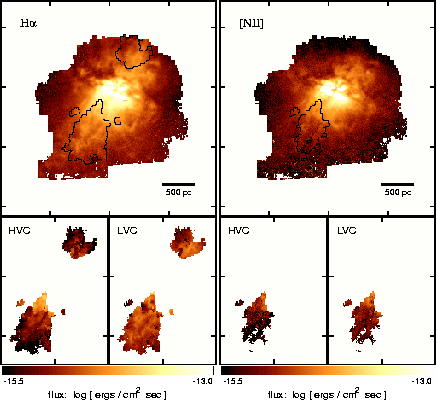
and [NII] lines across the majority of the field, well into the halo
of the galaxy. There are regions north of the galaxy's disk where
double components were fit to the H line profile, as well as
regions south of the disk where double components were fit to both the
H and [NII] lines. The [OIII] line was fit with a single Gaussian
component throughout the field, although visual inspection revealed
signs of line splitting in specific regions.
and [NII] lines across the majority of the field, well into the halo
of the galaxy. There are regions north of the galaxy's disk where
double components were fit to the H line profile, as well as
regions south of the disk where double components were fit to both the
H and [NII] lines. The [OIII] line was fit with a single Gaussian
component throughout the field, although visual inspection revealed
signs of line splitting in specific regions.
The region of acceptable fits is identical for the H and [NII]
maps, although the [NII] fits in the northern-most regions of the maps
have significantly higher errors, due to clipping of the 6583Å
profile by the limited spectral coverage. The region with sufficient
[OIII] flux for profile fitting is much smaller than that of H or
[NII]. The central regions of the galaxy are saturated in both the
H and [NII] observations.
We now describe the important features of each Fabry-Perot map. Each
spatial map is presented at approximately the same scale, with tick
marks separated by one arcminute ( 950 pc). The maps from the
H+[NII] data set contain regions in which the spectral lines are
split; these maps show both a flux-weighted total for the galaxy as
well as values for the individual components separately. These
components are referred to as the high-velocity component (HVC) and
the low-velocity component (LVC). North is up and east is to the left
in all images. The position angle of the major axis of the galaxy is
approximately 65o.
950 pc). The maps from the
H+[NII] data set contain regions in which the spectral lines are
split; these maps show both a flux-weighted total for the galaxy as
well as values for the individual components separately. These
components are referred to as the high-velocity component (HVC) and
the low-velocity component (LVC). North is up and east is to the left
in all images. The position angle of the major axis of the galaxy is
approximately 65o.
Figure 1 illustrates the flux distribution in the
light of H 6563Å and [NII] 6583Å. We measure a total
unsaturated H flux of  ergs cm-2
sec-1 and a total [NII] flux of
ergs cm-2
sec-1 and a total [NII] flux of  ergs
cm-2 sec-1. A rough comparison with the H imagery to be
presented in the next section indicates that the saturated nuclear
regions contribute an additional
ergs
cm-2 sec-1. A rough comparison with the H imagery to be
presented in the next section indicates that the saturated nuclear
regions contribute an additional  ergs
cm-2 sec-1 in the H line, or 17% of the total.
The flux is concentrated in the nucleus and along the minor axis, with
very little emission originating in the extended disk of the galaxy.
The nuclear line emission has saturated the detector in two
concentrations (``the eyes''), as well as a number of weaker ancillary
regions. In contrast, the minor axis emission is spatially extensive
and filamentary. Numerous long radial filaments can be seen extending
more than a kiloparsec from the nucleus, as well as complex
small-scale structures. Note, for example, the bright bow shock-like
arc approximately 500 pc SSE of the nucleus.
ergs
cm-2 sec-1 in the H line, or 17% of the total.
The flux is concentrated in the nucleus and along the minor axis, with
very little emission originating in the extended disk of the galaxy.
The nuclear line emission has saturated the detector in two
concentrations (``the eyes''), as well as a number of weaker ancillary
regions. In contrast, the minor axis emission is spatially extensive
and filamentary. Numerous long radial filaments can be seen extending
more than a kiloparsec from the nucleus, as well as complex
small-scale structures. Note, for example, the bright bow shock-like
arc approximately 500 pc SSE of the nucleus.
The morphology of the extraplanar gas differs between the two sides of
the galaxy, appearing more chaotic on the north side and showing signs
of collimation in the south. The southern H emission exhibits a
sharp edge on the eastern side. Furthermore, the emission to the south
is considerably brighter and more extensive, although there appears to
be an abrupt reduction in flux at a distance of approximately 500 pc
from the nucleus. Examination of the H and [NII] emission maps
reveals that, beyond 500 pc, the flux in the HVC drops rapidly, while
the flux in the LVC remains more uniform. We also find pervasive
diffuse emission at a low level throughout the halo of the galaxy.
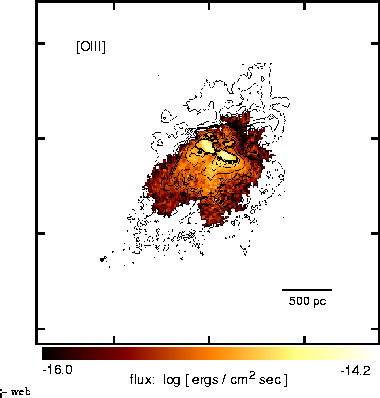
Figure 2 is a map of the flux from M82 at [OIII] 5007Å. We measure a total [OIII] flux of  ergs
cm-2 sec-1, more than an order of magnitude below that seen
at H and [NII]. There is essentially no emission from the disk at
this wavelength; the flux originates almost entirely within the
nucleus and along the southern minor axis of the disk. Although the
radial extent of the minor-axis emission is much smaller than that
seen in [NII] and H, the filamentary morphology is similar. Indeed,
excellent correlation is seen with the H flux map, which has been
contoured on Figure 2. A striking feature of the
[OIII] flux map is the presence of two distinct streams of emitting
gas, each extending along the southern minor axis from one of the
bright nuclear emission regions. These streams can also be identified
in the H flux map (Figure 1), although the much
more pervasive nature of the H emission makes the structure more
difficult to discern at small radii.
ergs
cm-2 sec-1, more than an order of magnitude below that seen
at H and [NII]. There is essentially no emission from the disk at
this wavelength; the flux originates almost entirely within the
nucleus and along the southern minor axis of the disk. Although the
radial extent of the minor-axis emission is much smaller than that
seen in [NII] and H, the filamentary morphology is similar. Indeed,
excellent correlation is seen with the H flux map, which has been
contoured on Figure 2. A striking feature of the
[OIII] flux map is the presence of two distinct streams of emitting
gas, each extending along the southern minor axis from one of the
bright nuclear emission regions. These streams can also be identified
in the H flux map (Figure 1), although the much
more pervasive nature of the H emission makes the structure more
difficult to discern at small radii.
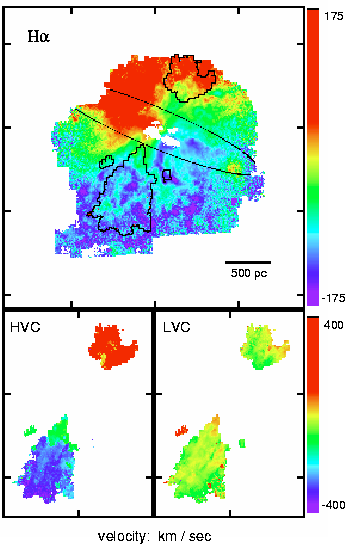 |
Figure 3 is a radial velocity map for the H-emitting
gas in M82. Two prominent trends are seen: first, there exists a
strong velocity gradient along the major axis of the galaxy,
consistent with normal disk rotation, with the eastern end moving away
from the observer. Second, a velocity transition is evident along the
minor axis of the galaxy: strong blue-shifting of the H emission is
seen south of the disk; strong red-shifting to the north. The
major-axis rotation signature merges into this minor axis motion in a
gradual fashion, although this may be due in part to the
flux-weighting procedure.
The HVC consists of highly redshifted emission in the north and highly
blueshifted emission in the south ( km s-1). The LVC
consists of emission at roughly the systemic velocity of the galaxy
(
km s-1). The LVC
consists of emission at roughly the systemic velocity of the galaxy
( km s-1; [de Vaucouleurs et al. 1991]), in both the north and
south. The northern and southern component pairs mirror each other
almost exactly in terms of relative velocity and kinematic structure.
Perhaps surprisingly, the velocities within each individual component
exhibit little radial or azimuthal variation. The exception to this
is the inner portion of the HVC, where the radial velocities approach
the systemic velocity.
km s-1; [de Vaucouleurs et al. 1991]), in both the north and
south. The northern and southern component pairs mirror each other
almost exactly in terms of relative velocity and kinematic structure.
Perhaps surprisingly, the velocities within each individual component
exhibit little radial or azimuthal variation. The exception to this
is the inner portion of the HVC, where the radial velocities approach
the systemic velocity.
A map of the line-of-sight velocities of the [NII]-emitting gas was
also produced, but is not presented here, as it provides little
additional information. The trends along both the major and minor
axes are identical to those seen at H, but at a lower
signal-to-noise ratio due to the decreased flux of [NII] line
emission. A velocity map of the [OIII]-emitting gas was not produced,
for the reasons outlined above.
Figure 4 shows the logarithm of the ratio of the [NII] 6583Å flux to the H 6563Å flux from M82. The most remarkable
feature in this map is the presence of a distinct region of low line
ratio (0.0-1.0) along the minor axis, south of the disk. This region
extends at least a kiloparsec in radius from the nucleus and is
narrower than the regions of minor axis filaments visible in the H and [NII] flux maps (Fig. 1). The region of low
ratios can be separated into two distinct structures, originating with
the bright central eyes of M82, similar to the structures seen at
smaller radii in the [OIII] 5007Å flux map
(Fig. 2).
Elsewhere in the galaxy, higher line ratios ( ) prevail,
particularly at large radii within the inclined disk. Discrete
HII regions can be seen in the disk as small concentrations
with the expected [NII]/H ratio of 0.5 ([Osterbrock 1989]). The
regions of extremely low line ratio to the north are a result of the
incompletely sampled [NII] line, and should be ignored.
) prevail,
particularly at large radii within the inclined disk. Discrete
HII regions can be seen in the disk as small concentrations
with the expected [NII]/H ratio of 0.5 ([Osterbrock 1989]). The
regions of extremely low line ratio to the north are a result of the
incompletely sampled [NII] line, and should be ignored.
 |
Figure 5 is a map of the logarithm of the ratio of the
[OIII] 5007Å flux to the H 6563Å flux from M82. The ratio
has been calculated over the entire spatial extent of the [OIII] emission, as seen in the flux map (Fig. 2). The
observed ratios are low (0.05) throughout the nucleus and
regions south of the disk, with the only apparent trend being a
gradual increase in the ratio with distance from the nucleus.