The Newsletter of the Friends of Palomar Observatory, Vol. 19 No. 2 – December 2025
Palomar Observations in Modern Astrophysics Part IV: A New Candidate Kilonova?
By Andy Boden
This artist's animation shows a hypothesized event known as a superkilonova. Initially, a massive star explodes in a supernova, which generates elements like carbon and iron. In the aftermath, two neutron stars are born, at least one of which is believed to be less massive than our Sun. The neutron stars spiral together, sending gravitational waves rippling through the cosmos, before merging in a dramatic kilonova. Kilonovae seed the universe with the heaviest elements, such as gold at platinum, which glow in red light as depicted in the animation. (Caltech/K. Miller and R. Hurt (IPAC))
“Multi-messenger astronomy” (MMA) refers to the study of astronomical sources by diverse indicators such as light and cosmic rays. The earliest multi-messenger connections for astronomical phenomena were made between optically visible solar flares that produced associated cosmic ray showers. Another important early development was the famous SN 1987A; roughly two hours before optical emission was observed bursts of neutrinos were detected by multiple experiments—implying a common origin for the two detections. Today most astronomers associate the multi-messenger usage with sources detected by both gravitational wave (GW; see LIGO, Virgo, KAGRA) and electromagnetic (EM) systems such as optical, infrared, or radio telescopes. The first human-observed GW/EM multi-messenger event was the famous “GW170817” detected nearly simultaneously in gravitational radiation and gamma rays (with extensive optical, IR, and radio followup of the event). The event is interpreted as a binary neutron star (NS) merger, a so-called “kilonova.” The scientific interest in and impact of GW170817 was both enormous and diverse: from testing the relative speed of gravitational waves and light (as expected they are the same within measurement error), to confirming the direct production of rapid neutron capture (“r”) process elements in the event ejecta—supporting theoretical models for NS-origin of r-process elements (e.g. gold) heavier than iron.
Palomar astronomers led by new Palomar Director Mansi Kasliwal are reporting (the likely) identification of a second multi-messenger event in August 2025, and the first discovered with an optical telescope—our own Samuel Oschin Telescope (SOT; Kasliwal et al 2025). GW event “S250818k” was reported on 18 August 2025 by the LIGO/Virgo/KAGRA collaboration as a low mass (< 1 Msun) compact binary merger candidate in their real-time alert stream. Within three hours the ZTF Collaboration initiated an optical search of the identified GW “localization” region with the SOT. While tens of possible candidates were identified from the first night’s data, only one, designated “ZTF25abjmnps,” appeared associated with a host galaxy at an estimated distance (“photometric redshift”) matching the distance estimate from GW-data modeling. Data from the subsequent two nights identified additional candidates, but none as promising as the initial candidate source.
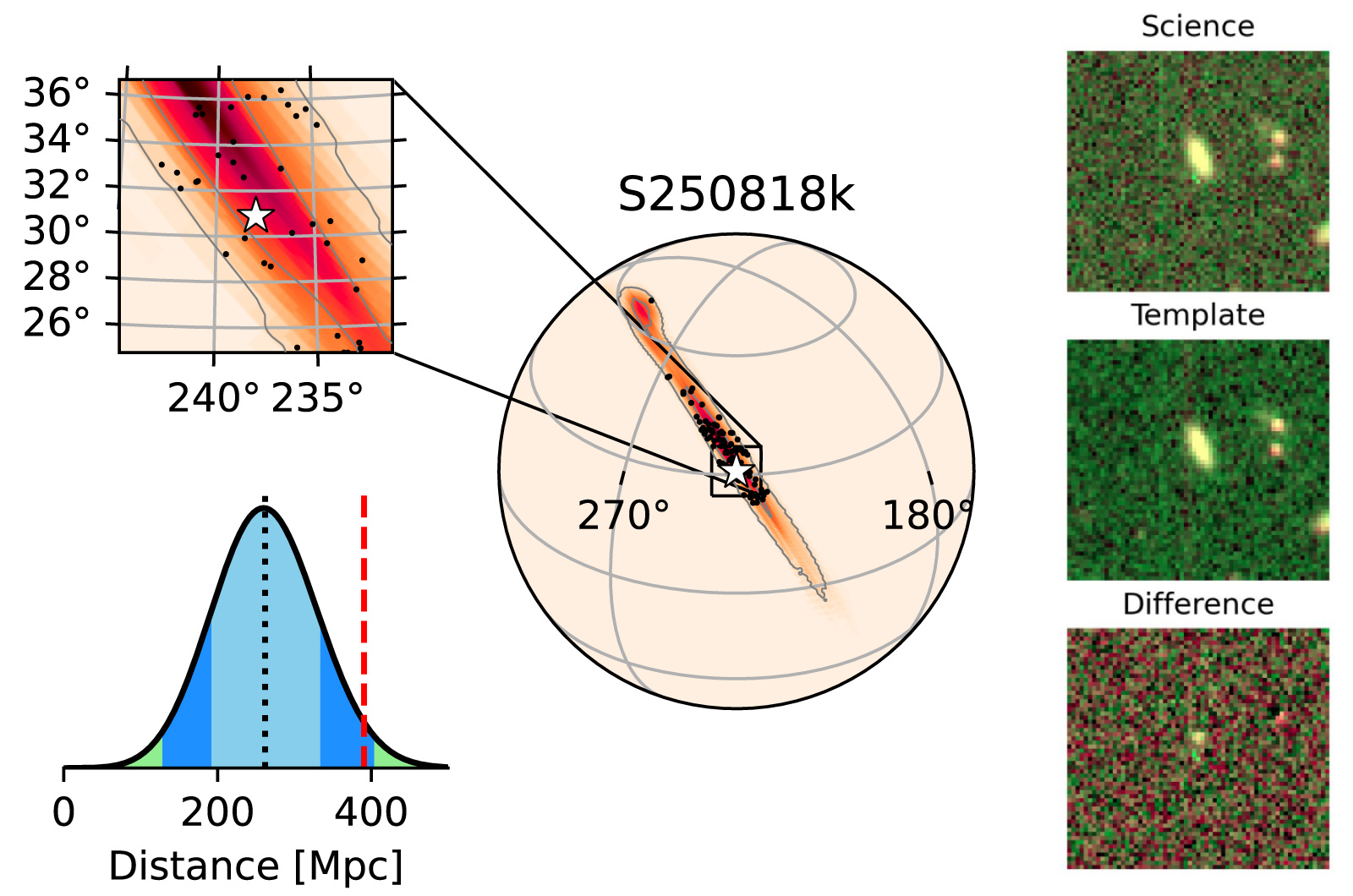
Discovery of candidate optical counterpart (ZTF25abjmnps) based on modeling of GW event (S250818k). GW sky and distance localizations (figure left) inform the optical (EM) transient search/detection (figure right)—plausibly associating the two transient events. (Kasliwal et al 2025)
Subsequent candidate monitoring in optical and near-IR photometry used telescopes from around the world, including the Palomar 200-in Hale Telescope. The candidate source was observed to dim just after GW detection, and then dramatically brighten (by 2 mag) in optical and near-IR colors over a ten day period. Both the Hale (with NGPS) and Keck1 (with LRIS) in Hawaiʻi among other telescopes obtained spectra of the evolving event showing emerging He line emission and broad Hα absorption. Kasliwal et al interpret the evolution of spectra and light curves for this candidate as most likely resulting from a stripped-envelope Type IIb supernova energizing the surrounding environment. The supernova inference complicates associating the GW and EM events, suggesting two compact bodies produced in the supernova explosion that subsequently merge producing the the GW signal.
Additional observation and modeling is ongoing, and new evidence may refine our understanding of this event and its EM and GW emission. But in a broader sense this result feels like a watershed moment: after the early, remarkable success of GW170817 the gravitational wave community has been steadily improving its capabilities (additional telescopes and sensitivity for better detection and localization, and improved data processing pipelines for near-real-time event alert announcements). At the same time the optical community has been refining its capabilities to plan and conduct efficient counterpart search strategies informed by improved localizations in the GW event alert streams, with the Zwicky Transient Facility (ZTF) leading the way. The broader lesson from this summer excitement is that Palomar and Caltech are very well-positioned to be a leader in the emerging field of GW/EM MMA; the combination of rapid survey capabilities of the venerable Oschin and sensitive imaging and spectroscopic capabilities of the venerable Hale (and the Kecks) are a particularly powerful combination pursuing GW source followup. As MMA continues to develop and the frequency of GW/EM associations increases Palomar will continue to be highly relevant in this rapidly developing field.
Welcoming Our New Director: Professor Mansi Kasliwal
By Annie Mejía
As many of you saw from the Caltech announcement on September 26, we are excited to welcome Professor Mansi Manoj Kasliwal as the new Director of the Palomar Observatory. This is a deeply significant moment—not only is Mansi the first woman to lead our esteemed facility, but her appointment celebrates a career fundamentally tied to the very instruments that define Palomar’s modern scientific mission. For those of us who have worked alongside her over the years, this feels like a well-deserved recognition of her exceptional talent and her deep, long-standing commitment to Palomar.

Prof. Mansi Kasliwal. (L. Hayashida/Caltech)
Mansi’s journey is a Palomar story through and through. She studied applied and engineering physics at Cornell before earning her PhD in Astrophysics at Caltech in 2011. Her affinity for the Mountain goes back to those graduate days, when she helped design and build the ground-breaking Palomar Transient Factory (PTF). That pioneering work set the standard for the transient sky surveys we run today, ultimately leading to the current powerhouse instrument, the Zwicky Transient Facility (ZTF). As a driving force behind ZTF, she has been instrumental in keeping our 48-inch Samuel Oschin Telescope at the cutting edge of time-domain astrophysics, helping us catch those fleeting "cosmic fireworks" as they rapidly brighten and fade.
Her primary scientific focus is multi-messenger astronomy, searching for the light signals (electromagnetic counterparts) from catastrophic events like the mergers of neutron stars—phenomena also detected by gravitational wave observatories. This specialized, high-stakes research earned her the prestigious New Horizons in Physics Prize from the Breakthrough Foundation in 2022. Her overall scientific impact is substantial, marked by her role as a tenured professor and a publication record of over 440 refereed papers, confirming her standing as a prominent voice in modern astrophysics.
Mansi’s visionary approach is best exemplified by her commitment to the infrared sky, where cosmic dust obscures many crucial stellar events. She championed the development of two key Palomar instruments specifically for this frontier: Palomar Gattini-IR (PGIR), which provided an unprecedented wide-field view, and the more powerful, Wide-field INfrared Transient ExploreR (WINTER) telescope, which began operations in 2024. These instruments, designed and tested right here, not only extend our observational reach but also reinforce Palomar’s status as a hub for instrument innovation.
On a global scale, her leadership is evident as the Principal Investigator of the Global Relay of Observatories Watching Transients Happen (GROWTH) initiative, an international network coordinating around-the-clock follow-up on cosmic events. This commitment to collaborative, high-cadence astronomy, along with her dedication to upgrading our facility with new technology like the Next Generation Palomar Spectrograph (NGPS), ensures that Palomar’s unique set of telescopes will remain at the absolute forefront of discovery for years to come. We are enthusiastic to begin this exciting new chapter under Professor Kasliwal’s direction.
Big Skies, Bright Ideas: Palomar at the McDonald Observatory AHO Docent Workshop
By Ashley Wilkinson
When I arrived for the second annual Alliance of Historic Observatories (AHO) docent workshop, I drove three hours from the El Paso International Airport to the McDonald Observatory, which is owned and operated by the University of Texas at Austin. Located in the Davis Mountains, the McDonald Observatory sits sixteen miles northwest of Fort Davis, Texas, surrounded by ranch-land, rolling hills, and yes—Texas sized mountains. Graced by a generous monsoon season this year, the skies were dotted with big white clouds, and the surrounding land and mountains had vibrant bursts of green. Thirty seven miles to the south you’ll find Marfa, home of the quirky Marfa Lights and the yearly festival that draws star-gazers of all kinds to the greater area. Just beyond lies Big Bend National Park, which is a designated International Dark Sky Reserve.
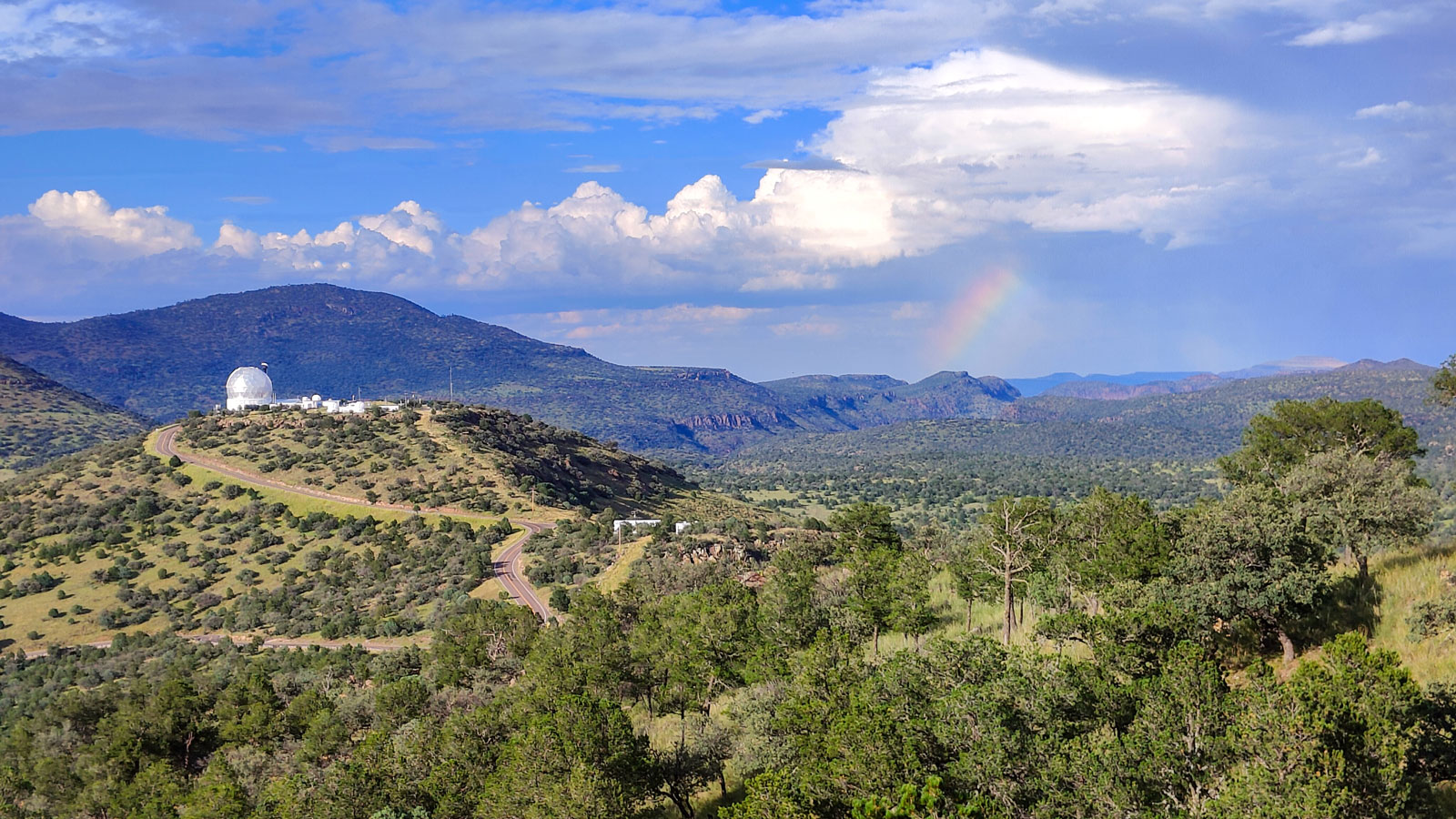
The summit of Mt. Fowlkes and the Hobby-Eberly Telescope dome in the distance. (A. Wilkinson/Palomar)
As night fell and I settled in, I met fellow representatives from sister observatories and joined one of the observatory’s famed public star parties. Tickets tend to sell quickly during peak stargazing events and holidays. I quickly realized that the observatory, and the region it calls home, is a special place where you can truly feel the wild spirit of Texas: untouched, preserved, wild, and where the stars are every bit as big and bright as the famous Gene Autry song sings.
Among my favorite moments was touring the 82-inch Otto Struve Telescope, one of McDonald’s original giants, followed by an opportunity for an eyepiece viewing. Standing beneath the observatory’s towering domes and touring its history, I was reminded of Palomar’s own legacy and how these observatories, though scattered across the country, are united by a common purpose: sharing the wonder of the cosmos.
Over the next three days, the McDonald staff hosted an engaging and thoughtfully organized workshop that brought together representatives from historic observatories across the country. Attendees included Detroit, Cincinnati, Yerkes, Lowell, McDonald, Eastern Arizona Discovery Park, Mount Wilson, Lick, and Palomar observatories, along with StarDate who was also in attendance. Each observatory gave a presentation highlighting their public programs, docent activities, and educational initiatives. Between sessions, we exchanged stories about our shared challenges and creative solutions on how to reach new audiences, support volunteers and staff, and keep astronomy relevant in a rapidly changing world, especially in regard to light pollution.
What stood out most throughout the workshop was how much passion and creativity each observatory brings to engaging their communities. While the presentations gave us a glimpse into how each site approaches docent training, public programming, and community connections, the breakout sessions helped me dive deeper into topics such as program evaluation, K-12 engagement and accessibility initiatives like tactile “braille” constellations for visitors with visual impairments and hearing-assist devices for public talks. These conversations sparked ideas I hope to bring to Palomar over time.
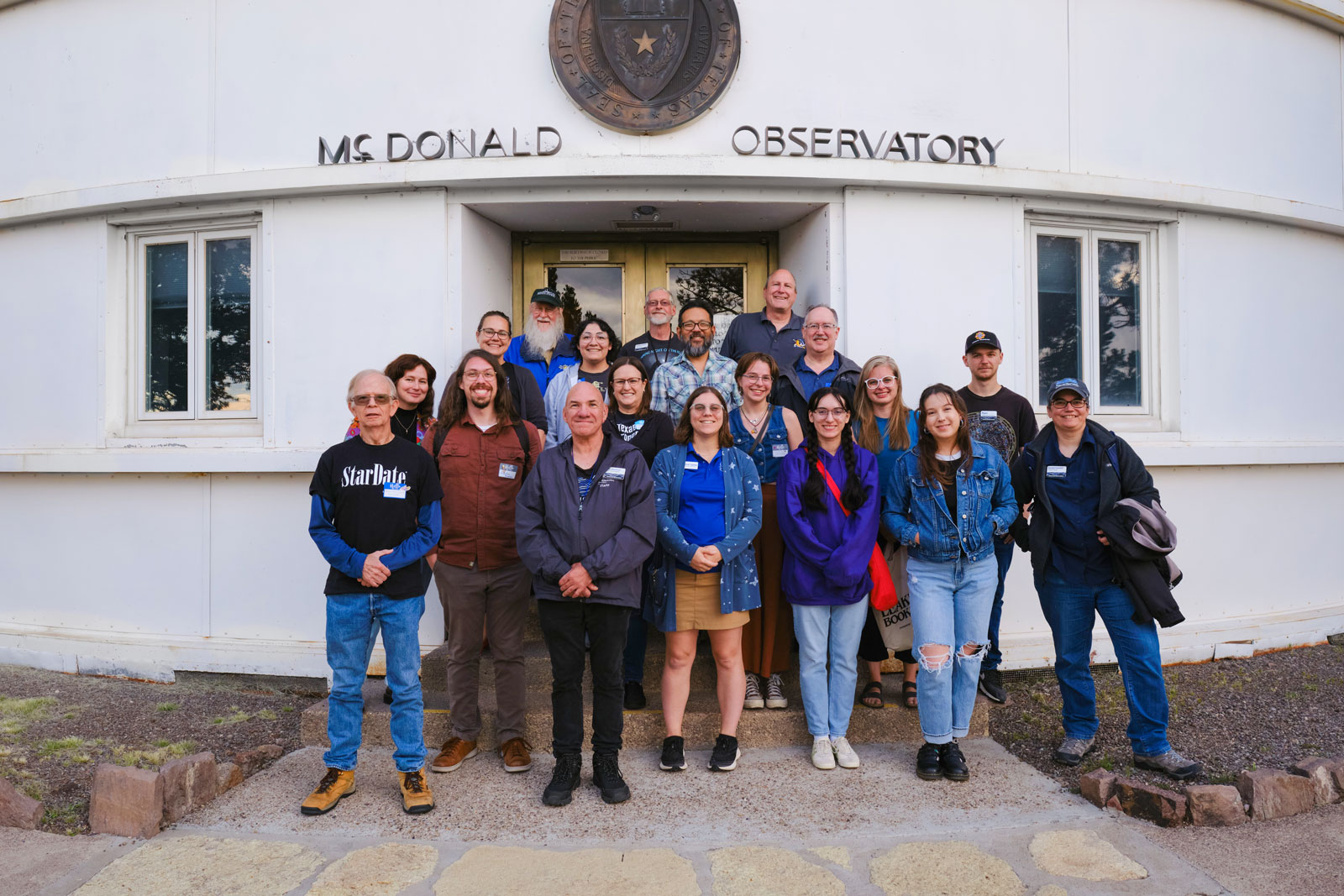
AHO docent workshop attendees at the entrance of the Otto Struve Telescope dome. (A. Edmister/Detroit Observatory)
As I approach my first year anniversary in this role at Palomar, I will be focused on developing initiative concepts to extend our community outreach. For instance, I would like to explore visiting nearby schools and libraries to deliver virtual field trips to them, as scheduling buses and funding transportation are often the biggest hurdles for schools to make it up to Palomar. I would also like to consider diversifying our tour portfolio—for example, working with some of our current docents to develop an engineering tour of the telescope, as well as a family-accessible tour targeted to children and their parents. Another possible initiative is to develop mini teacher workshop days—focused professional development sessions where educators can connect with Palomar staff, tour the telescopes, and leave with classroom-ready activities and digital resources.
There was a lot to take in, and I wish the Palomar team could do all of the amazing things these sister observatories do! I am so excited to explore ways to adapt some of the ideas to serve our community. Whether that’s connecting more with local schools and libraries, developing brief professional learning sessions for educators, or strengthening our docent program through new outreach opportunities. The AHO docent workshop reminded me that while each site faces unique challenges, we all share a common sky and collective mission to inspire others to look up.
Seasonal Highlights from Palomar Observatory
Visitors Gallery Lighting Upgrade
The Visitors Gallery received a much-needed refresh this year with the installation of new, modern light fixtures. The new adjustable lighting makes the space more welcoming and more comfortable for our guests, while also helping to reduce glare on the glass so visitors can enjoy clearer views of the Observing Floor and the Hale Telescope. The Gallery now feels decades newer. We extend our sincere thanks to Greg Boudreau for his hard work and care in installing the new fixtures and bringing this long-overdue improvement to life.
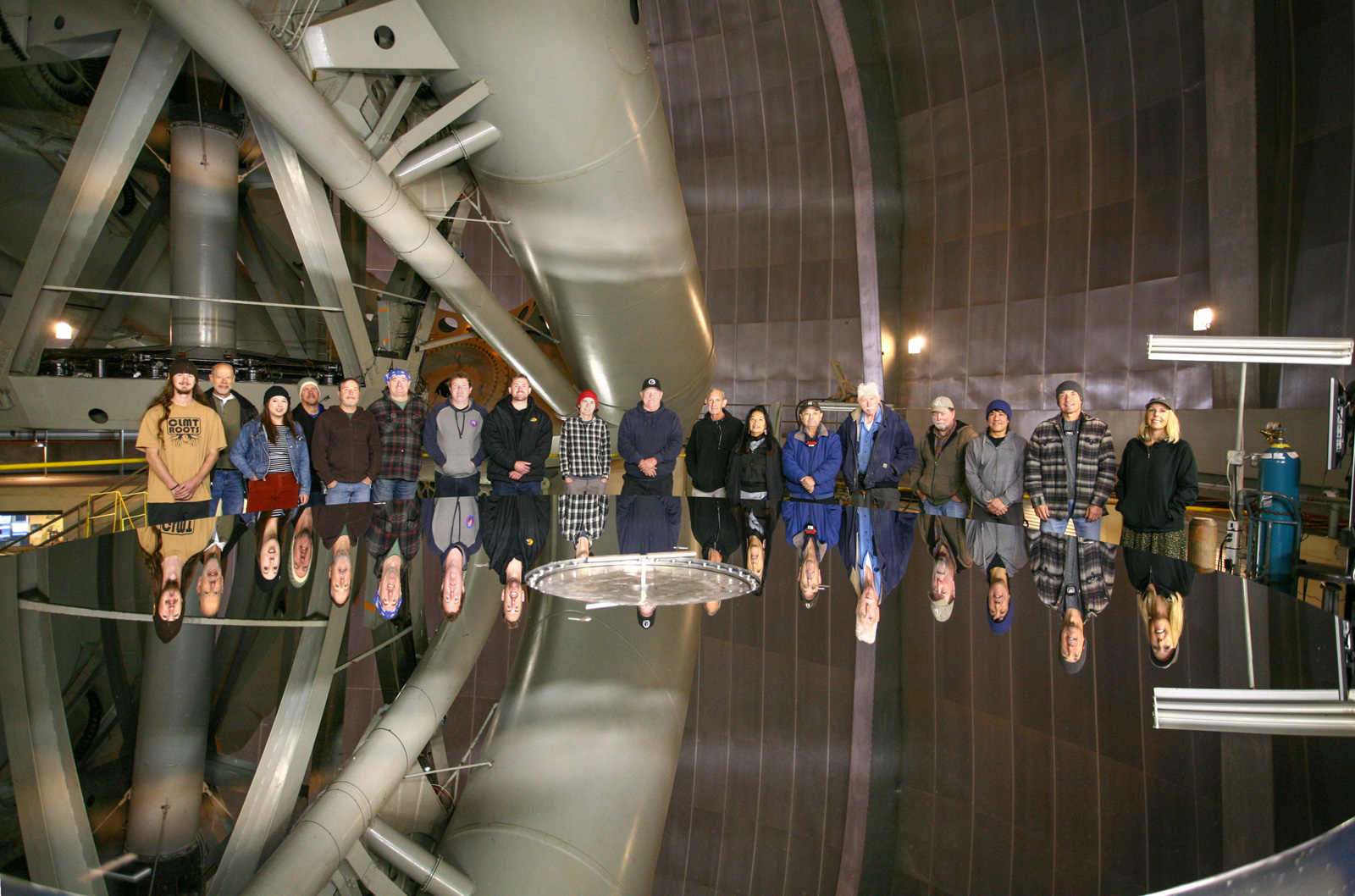
A proud moment: the Palomar team with the 200-inch primary mirror following its successful aluminum recoating. (S. Flanders/Palomar)
Mirror Recoating Success
We’re delighted to share that the 200-inch telescope received its new aluminized coating during the first week of November—with excellent results. Reflectivity has improved significantly, matching some of our strongest historic measurements, and follow-up engineering tests confirmed smooth performance across the board. This was a true team effort, and we extend our heartfelt thanks to everyone involved. Our facilities crew, engineers, and technical staff worked early mornings and late nights to ensure the process went safely and smoothly, and we are deeply grateful for their dedication.
Milestones for the New Spectrograph
The new general-purpose optical spectrograph (NGPS)—developed with NAOC/NIAOT—continues to advance toward full commissioning. Following the successful deployment of the red and infrared channels earlier this year, we achieved first light on the ultraviolet and green channels on 9–10 December 2025. This marks an exciting step forward as we prepare to bring greatly improved sensitivity and operational efficiency to the 200-inch. Our teams’ persistence and hard work are making this next-generation instrument a reality.
Staff and Docent Holiday Social
On 6 December 2025, our staff and docents came together for a warm and joyful holiday gathering, celebrating the close of another vibrant outreach season. It was wonderful to share good food, conversation, and reflections on everything we accomplished together this year. Our docent corps—many of whom volunteer every weekend for months on end—remain at the heart of our outreach mission. Their enthusiasm, generosity, and love for this observatory are truly inspiring, and we are deeply thankful for each of them.
Warm Holiday Wishes
As the year draws to a close, we extend our sincerest holiday greetings to our entire Palomar community—staff, volunteers, partners, supporters, and friends. Thank you for the passion, care, and curiosity you bring to this place. Your work and enthusiasm help keep the spirit of discovery alive here on the mountain. We look forward to another year of collaboration and shared wonder under the Palomar sky.


Questions? We've answered many common visiting, media, and academic questions in our public FAQ page.
Please share your feedback on this page at the
COO Feedback portal.
Big Eye 19-2
Last updated: 16 December 2025 AFB/ACM