Although the discovery of split emission lines ([Axon & Taylor 1978]) and the minor-axis X-ray halo ([Watson, Stanger, & Griffiths 1984]) have virtually eliminated this alternate interpretation for the optical filaments (although see [Rohan, Morrison, & Sadun 1987]), the polarization measurements remain poorly understood. Recent observations (e.g., [Scarrott, Eaton, & Axon 1991]) indicate that the optical filaments may indeed contain a scattered component, but even then there is uncertainty as to the source of the polarization, i.e. the nucleus ([Visvanathan 1974]) or the entire disk ([Solinger & Markert 1975]). Unfortunately, with few exceptions (e.g., [Schmidt, Angel, & Cromwell 1976]; [Bland & Tully 1988]; [Doane 1993]; [Suchkov et al. 1994]), the presence of a halo component in M82 has been largely ignored.
Our detailed analyses in H and [NII] clearly confirm the existence
of the smooth exponential halo noted by [Bland & Tully 1988].
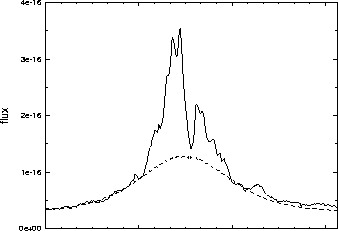
Figure 7 illustrates the flux along a narrow
(
and [NII] clearly confirm the existence
of the smooth exponential halo noted by [Bland & Tully 1988].
Figure 7 illustrates the flux along a narrow
( 9'') band parallel to and approximately 45'' southeast of the major axis of the galaxy. The flux due to the
outflow filaments can be seen superimposed upon an exponentially
decreasing background. The halo has be detected across our entire
region of fit lines, approaching a flux level of 10-15 ergs
cm-2 sec-1 arcsec-2 at a radius of 1 kpc.
9'') band parallel to and approximately 45'' southeast of the major axis of the galaxy. The flux due to the
outflow filaments can be seen superimposed upon an exponentially
decreasing background. The halo has be detected across our entire
region of fit lines, approaching a flux level of 10-15 ergs
cm-2 sec-1 arcsec-2 at a radius of 1 kpc.
We have estimated the radial profile of the halo flux at H with an
exponential function:
 |
(1) |
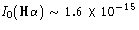 ergs cm-2
sec-1 arcsec-2 Å-1 and
ergs cm-2
sec-1 arcsec-2 Å-1 and  pc. This
profile has been overlayed on the cut in Figure 7. For
the observed halo line width of 350 km s-1, the integrated H flux is
pc. This
profile has been overlayed on the cut in Figure 7. For
the observed halo line width of 350 km s-1, the integrated H flux is  ergs cm-2 sec-1. This
compares with an observed flux from the filaments and
unsaturated nucleus of
ergs cm-2 sec-1. This
compares with an observed flux from the filaments and
unsaturated nucleus of  ergs cm-2
sec-1. For a distance of 3.25 Mpc this implies a total H luminosity from the halo of
ergs cm-2
sec-1. For a distance of 3.25 Mpc this implies a total H luminosity from the halo of  ergs sec-1.
The azimuthally symmetric polarization pattern of the halo in
broadband light ([Schmidt, Angel, & Cromwell 1976]) suggests a scattering origin. The halo
is known to comprise cold neutral atoms ([Cottrell 1977]), relativistic
electrons ([Seaquist & Odegard 1991]), dust ([Visvanathan & Sandage 1972]) and warm ions
([Bland & Tully 1988]). If we associate the line-emitting halo with the
polarized component, the line width (350 km s-1 FWHM) reflects
either the motion of scattering mirrors embedded in a warm medium or
the ``beam-averaged'' projected kinematics of the nuclear and
large-scale disk gas. If the observed line dispersion arises from
thermal motions of electrons, the kinetic temperature must be less
than 1000 K, at which point the flux from recombination would
overwhelm the scattered flux for any reasonable halo density ( cm-3; [Cottrell 1977]). Dust scattering is expected to be
much more efficient in any case. The ratio of the scattering optical
depths can be written
cm-3; [Cottrell 1977]). Dust scattering is expected to be
much more efficient in any case. The ratio of the scattering optical
depths can be written
 |
(2) |
 and
and  are the dust and electron scattering cross sections.
For , we form the more conservative weighted mean of the MRN
([Mathis, Rumpl, & Nordsieck 1977]) grain distribution for which
are the dust and electron scattering cross sections.
For , we form the more conservative weighted mean of the MRN
([Mathis, Rumpl, & Nordsieck 1977]) grain distribution for which  m. In the local ISM, the dust-to-gas number density
ratio is
m. In the local ISM, the dust-to-gas number density
ratio is  ([Ostriker & Silk 1973]) although this
depends strictly on the grain composition. With the conservative
assumption of a totally ionized halo, we deduce a scattering ratio
([Ostriker & Silk 1973]) although this
depends strictly on the grain composition. With the conservative
assumption of a totally ionized halo, we deduce a scattering ratio
 , verifying the relative importance of dust
scattering. [Schmidt, Angel, & Cromwell 1976] demonstrate that a reasonable optical depth
to dust scattering is
, verifying the relative importance of dust
scattering. [Schmidt, Angel, & Cromwell 1976] demonstrate that a reasonable optical depth
to dust scattering is  from a comparison of the halo
broadband flux and the estimated disk flux.
from a comparison of the halo
broadband flux and the estimated disk flux.
The halo dust could reside in an extended neutral or warm ionized
medium, some fraction of which could be supplied by the energetic wind
([Burbidge, Burbidge, & Rubin 1964]). We now compare the timescale for dust destruction by
sputtering with the estimated age of the starburst wind,  years (e.g., [Lynds & Sandage 1963]; [Bland & Tully 1988]). From
[Ostriker & Silk 1973], the timescale for grain sputtering is
years (e.g., [Lynds & Sandage 1963]; [Bland & Tully 1988]). From
[Ostriker & Silk 1973], the timescale for grain sputtering is
 |
(3) |
 at the
threshold sputtering temperature of
at the
threshold sputtering temperature of  K to
K to  for temperatures of 107-108 K.
At the low temperatures expected in a galactic halo,
 K, the lifetime of dust is greater than 107 yrs,
comparable to or longer than the lifetime of the outflow. However,
any dust located directly in the hot (
K, the lifetime of dust is greater than 107 yrs,
comparable to or longer than the lifetime of the outflow. However,
any dust located directly in the hot ( K) X-ray-emitting
wind survives for no more than 105 years, and has therefore been
destroyed. Such an effect is supported by low-resolution radio maps
of the M81/M82 region, which indicate an anti-correlation between the
wind lobes and HI column density ([Cottrell 1977]). We note that more
recent studies of gas-grain sputtering and grain-grain collisions
([Tielens et al. 1994]; [Jones, Tielens, & Hollenbach 1996]) suggest that grains may be able to
survive much longer than previously thought. However, most of these
studies are specific to the three-phase ISM in the Galaxy, and it
remains unclear precisely how the results should be extended to
galactic wind systems, which characteristically involve higher
temperatures (108 K vs. 106 K) and larger velocities (600 km s-1 vs. 200 km s-1) than standard ISM models.
K) X-ray-emitting
wind survives for no more than 105 years, and has therefore been
destroyed. Such an effect is supported by low-resolution radio maps
of the M81/M82 region, which indicate an anti-correlation between the
wind lobes and HI column density ([Cottrell 1977]). We note that more
recent studies of gas-grain sputtering and grain-grain collisions
([Tielens et al. 1994]; [Jones, Tielens, & Hollenbach 1996]) suggest that grains may be able to
survive much longer than previously thought. However, most of these
studies are specific to the three-phase ISM in the Galaxy, and it
remains unclear precisely how the results should be extended to
galactic wind systems, which characteristically involve higher
temperatures (108 K vs. 106 K) and larger velocities (600 km s-1 vs. 200 km s-1) than standard ISM models.
Given the sputtering timescales, if the dust has been delivered into the halo by the wind, it must be as a component of cooler material entrained by the hot wind itself. However, this implies that the halo dust and optical emission line filaments may then have the same origin and morphology, yet the polarization observations do not seem to indicate a minor-axis concentration in the dust distribution ([Solinger & Markert 1975]; [Schmidt, Angel, & Cromwell 1976]; [Scarrott, Eaton, & Axon 1991]). We also do not observe substantial redshifted emission south of the galaxy, as would be expected from mirrors moving with the outflow.
Alternatively, dust may have been forced into the halo at an early stage of the outflow, at a time when it was dominated much more by radiation from massive stars in the central burst than by supernovae. Such a mechanism has been hypothesized by [Ferrara 1997] to explain the appearance of high-z dust in the Galaxy and other edge-on spirals. It has been demonstrated that radiation pressure is sufficient to evacuate a large fraction of the dust near an active star-forming region into the halo, creating a dust distribution which varies slowly with height above the disk. Given the current importance of radiation effects in the inner portion of the M82 outflow (see Section 4.3.6 below) and the extensive nature of the observed dusty halo, such a scenario seems a reasonable model.
Regardless of any mechanism of relocating disk dust into the halo,
clearly the hypothesized encounter between M81 and M82
 years ago ([Cottrell 1977]; [Yun, Ho, & Lo 1994]) has played an
important role in the evolution of the halo in M82. (This encounter
is also thought to have initiated the central starburst in M82, e.g.,
[Mihos & Hernquist 1994].) Radio observations have shown massive clouds of HI surrounding both galaxies, with large arcs and bridges joining them
and the nearby galaxy NGC 3077 (e.g., [Davies 1974]; [Yun, Ho, & Lo 1994]). The
large-scale velocity structure of this gas blends with the global H velocity trends in M82, matching the systemic velocity and even the
minor-axis velocity gradient ([Cottrell 1977]). The HI cloud is clearly
extensive enough to replenish dust that has been destroyed by
sputtering. Moreover, this massive reservoir of atomic gas should
help to maintain the tenuous halo gas itself in M82, a component that
is required by hydrodynamical models in order for the outflowing wind
to produce observable structures ([Suchkov et al. 1994]).
years ago ([Cottrell 1977]; [Yun, Ho, & Lo 1994]) has played an
important role in the evolution of the halo in M82. (This encounter
is also thought to have initiated the central starburst in M82, e.g.,
[Mihos & Hernquist 1994].) Radio observations have shown massive clouds of HI surrounding both galaxies, with large arcs and bridges joining them
and the nearby galaxy NGC 3077 (e.g., [Davies 1974]; [Yun, Ho, & Lo 1994]). The
large-scale velocity structure of this gas blends with the global H velocity trends in M82, matching the systemic velocity and even the
minor-axis velocity gradient ([Cottrell 1977]). The HI cloud is clearly
extensive enough to replenish dust that has been destroyed by
sputtering. Moreover, this massive reservoir of atomic gas should
help to maintain the tenuous halo gas itself in M82, a component that
is required by hydrodynamical models in order for the outflowing wind
to produce observable structures ([Suchkov et al. 1994]).