


 and [OIII] flux maps
(Figs. 1 and 2) reveal little ionized
gas in the extended disk of M82, outside of the central nuclear
starburst region, as found by slit spectra ([O'Connell & Mangano 1978]). Small
concentrations of line emission that do exist in the disk outside of
the starburst, such as the regions 0.'5 east of the nucleus (see
also [O'Connell & Mangano 1978]; Fig. 3), appear to be giant HII regions. The
[NII]/H ratio map (Fig. 4) indicates moderate values
for these regions (
and [OIII] flux maps
(Figs. 1 and 2) reveal little ionized
gas in the extended disk of M82, outside of the central nuclear
starburst region, as found by slit spectra ([O'Connell & Mangano 1978]). Small
concentrations of line emission that do exist in the disk outside of
the starburst, such as the regions 0.'5 east of the nucleus (see
also [O'Connell & Mangano 1978]; Fig. 3), appear to be giant HII regions. The
[NII]/H ratio map (Fig. 4) indicates moderate values
for these regions ( 0.56), consistent with a cooler range of
photoionized HII regions (
0.56), consistent with a cooler range of
photoionized HII regions (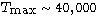 K, [Evans & Dopita 1985];
[Veilleux & Osterbrock 1987]). Such regions exhibit low levels of [OIII] emission,
consistent with our non-detection in Figure 2.
Although the high extinction in the disk of M82 (3-27 mag;
[O'Connell et al. 1995]; [McLeod et al. 1993]) serves to hide smaller HII regions
from our optical observations, the paucity of large HII regions
suggests that the level of star formation must be low outside of the
central starburst. This conclusion has also been reached by
multi-epoch radio supernovae studies (e.g., [Kronberg, Biermann, & Schwab 1985];
[Huang et al. 1994]). The weak nature of the [OIII] emission implies a
high overall metallicity in M82, as has been suggested by previous
observations (e.g., [Duffy et al. 1987]; [Gaffney & Lester 1992]), and as is anticipated
due to chemical enrichment by the starburst (e.g., [Kobulnicky & Skillman 1996]).
K, [Evans & Dopita 1985];
[Veilleux & Osterbrock 1987]). Such regions exhibit low levels of [OIII] emission,
consistent with our non-detection in Figure 2.
Although the high extinction in the disk of M82 (3-27 mag;
[O'Connell et al. 1995]; [McLeod et al. 1993]) serves to hide smaller HII regions
from our optical observations, the paucity of large HII regions
suggests that the level of star formation must be low outside of the
central starburst. This conclusion has also been reached by
multi-epoch radio supernovae studies (e.g., [Kronberg, Biermann, & Schwab 1985];
[Huang et al. 1994]). The weak nature of the [OIII] emission implies a
high overall metallicity in M82, as has been suggested by previous
observations (e.g., [Duffy et al. 1987]; [Gaffney & Lester 1992]), and as is anticipated
due to chemical enrichment by the starburst (e.g., [Kobulnicky & Skillman 1996]).
The nuclear emission is dominated by two large saturated regions, each
approximately 200 pc in diameter, and centered 125 pc from the
2 micron stellar nucleus (see Fig. 1). These
regions correspond to knots A and C of [O'Connell & Mangano 1978] and are known
to be extremely high surface brightness ``clusters of clusters'' of
young ( Myr) stars ([O'Connell et al. 1995]). Also identifiable in
Figure 1 are knots D and E (also saturated), as
well as knots F, G, and H. Knot B is extremely faint at H wavelengths, especially when compared to broadband ([O'Connell & Mangano 1978]) and
ultraviolet ([Hennessy 1996]) observations, suggesting a higher gas
content in the inner regions of the galaxy. The outflow can be traced
to knots A and C. This relationship is particularly
well-demonstrated by the [NII]/H map (Fig. 4) and the
[OIII] flux map (Fig. 2).
Myr) stars ([O'Connell et al. 1995]). Also identifiable in
Figure 1 are knots D and E (also saturated), as
well as knots F, G, and H. Knot B is extremely faint at H wavelengths, especially when compared to broadband ([O'Connell & Mangano 1978]) and
ultraviolet ([Hennessy 1996]) observations, suggesting a higher gas
content in the inner regions of the galaxy. The outflow can be traced
to knots A and C. This relationship is particularly
well-demonstrated by the [NII]/H map (Fig. 4) and the
[OIII] flux map (Fig. 2).
 |
We have plotted the H radial velocities along a straight line
corresponding to the major axis of the galaxy in
Figure 6 (panel c), along with a number of rotation
curves from the literature at a range of wavelengths. The published
systemic velocity of M82, 203 km s-1 ([de Vaucouleurs et al. 1991]), corrected to a
heliocentric value of 208.7 km s-1, has been subtracted from the H Fabry-Perot data. The rotation curve rises to approximately 100 km s-1 within 9'' (140 pc) of the nucleus and remains
relatively flat to the edges of the observations. No substantial
fall-off in the rotation curve is seen, due primarily to the limited
radial extent of line emission from the disk. The observed rotation
curve matches well those found at H by [Heckathorn 1972] (his Fig. 12) and
[McKeith et al. 1993] (panel d of Fig. 6), including the
turn-over and asymptotic velocities and the nuclear velocity gradient
(11 km s-1 arcsec-1). Figure 6 also
illustrates an increase in the central velocity gradient with
wavelength. As has been pointed out by other authors (e.g.,
[McKeith et al. 1993]), this effect is indicative of the large extinction
toward the nuclear regions of the galaxy.
The H rotation curve also correlates well with that of the 250 pc
nuclear ring seen in molecular emission lines (e.g., [Loiseau et al. 1990]).
The double-lobed structure of the central H emission is suggestive
of an edge-on ring structure as well, interior to the molecular ring.
The starburst could be identified with the ring of ionized gas and is
probably propagating outward, fueled by the cold gas in the molecular
ring ([Waller, Gurwell, & Tamura 1992]; cf. [Shen & Lo 1995]). This ring may also provide
much of the extinction toward the nucleus of M82 (e.g., [Telesco & Gezari 1992]).
The dynamic conditions of the central regions would have removed most
of the obscuring material interior to the ring, as has been suggested
in our Galaxy (e.g., [Becklin, Gatley, & Werner 1982]). The resolution of the central
star clusters by recent HST observations ([O'Connell et al. 1995]) suggests that
any such ring would be very clumpy however, and the two bright regions
may indeed represent real spatial enhancements in the distribution of
ionized gas and star formation. The relationship between this ring
structure and the proposed bar in M82 ( pc; [Telesco et al. 1991];
[Achtermann & Lacy 1995]) is not clear.
pc; [Telesco et al. 1991];
[Achtermann & Lacy 1995]) is not clear.
The [NII]/H line ratio map (Fig. 4) shows a high ratio
in the disk, especially at large radii, where the value is observed to
exceed 1.0. The actual line ratios in the disk may be even slightly
higher and possibly more uniform, due to dilution by the central
starburst and the halo. Such high ratios are by no means rare in the
nuclei of disk galaxies ([Keel 1983]), particularly LINERS (e.g.,
NGC 4319 [[Sulentic & Arp 1987]], NGC 5194 [[Ford et al. 1985]; [Goad & Gallagher 1985]]), and
are understood to originate with shock excitation and/or
photoionization by a power-law source ([Veilleux & Osterbrock 1987]). Although it is
unlikely that M82 harbors an AGN (e.g., [Rieke et al. 1980]; [Colina & Pérez-Olea 1992];
[Muxlow et al. 1994]), a comparison with other galaxies which exhibit
pervasive high [NII]/H line ratios in their extended disks is
instructive: studies of NGC 3079 ([Veilleux et al. 1994]) and especially
NGC 1068 ([Bland-Hawthorn, Sokolowski, & Cecil 1991]) have found high [NII]/H ratios of 0.6-1.3
across much of the inner disk. In NGC 1068, the disk HII regions
are found to reside in regions of lower [NII]/H ratio
(0.3-0.8), while the disk as a whole is permeated with gas
exhibiting the higher ratios, similar to what we observe in M82. In
order to boost this forbidden line to recombination line ratio, the
``heating per ionization'' must be high, for which most models require
high energy photons, energetic electrons, or a dilute radiation bath
([Sokolowski 1992]).
In the case of M82, an attractive candidate to enhance the [NII]/H
ratio in the disk is the concept of ``mixing layers'' ([Slavin & Cox 1993];
[Voit, Donahue, & Slavin 1994]). The turbulence resulting from the interaction of hot
supernovae remnants with the ambient ISM creates an intermediate
temperature phase, which models suggest emits a radiation field
somewhat harder than thermal bremsstrahlung. This process can produce
[NII]/H ratios in excess of 1.0 ([Slavin, Shull, & Begelman 1993]). By employing soft
X-rays as the photoionization mechanism, mixing ratios have been used
to model line emission ratios of up to 3-4 in cooling flows
([Donahue & Voit 1991]; [Crawford & Fabian 1992]). Considering the current optical
appearance of the disk of M82, its interaction with the galaxy M81
approximately 108 years ago, and the energetic activity associated
with the nuclear starburst, a turbulent inner disk would not be
unexpected.
However, as mentioned above, our observations do not detect
significant numbers of star forming regions outside the starburst
nucleus. Even if this is attributed to high levels of extinction in
the disk, other wavebands confirm the low level of star formation. All
of the radio supernovae discovered by [Kronberg, Biermann, & Schwab 1985] are within 300 pc
of the galaxy's nucleus, well inside the region of highest [NII]/H
ratios. The diffuse X-ray flux in the disk has also been shown to
decrease rapidly with radius, implying a reduced star formation rate
outside the nuclear regions ([Bregman, Schulman, & Tomisaka 1995]). Other models for
producing high [NII]/H ratios in the disk must be considered, such as
chemical enrichment and cosmic ray heating. A combination of shock
and photoionization may also provide a solution (e.g., [Hunter & Gallagher 1990]),
although detailed models are not yet available.