


 sec) H
 imagery
at the University of Hawaii 88-inch telescope on Mauna Kea
(Fig. 8). We imaged a 6' circular field, a
factor of two larger than our Fabry-Perot field. The optical
filaments associated with the minor axis outflow are visible across
the entire field, to radial distances of at least 3.5 kpc to the north
and 2 kpc to the south. This represents approximately half the extent
of the soft X-ray halo (see below). The filaments are bright within a
kiloparsec of the disk, particularly in the south. In these inner
regions, a web of long (
imagery
at the University of Hawaii 88-inch telescope on Mauna Kea
(Fig. 8). We imaged a 6' circular field, a
factor of two larger than our Fabry-Perot field. The optical
filaments associated with the minor axis outflow are visible across
the entire field, to radial distances of at least 3.5 kpc to the north
and 2 kpc to the south. This represents approximately half the extent
of the soft X-ray halo (see below). The filaments are bright within a
kiloparsec of the disk, particularly in the south. In these inner
regions, a web of long ( 300 pc) filaments appear distributed
roughly parallel to the minor axis, amidst a ``foam'' of smaller
emission structures. Beyond a kiloparsec in radius, the filamentary
structure breaks up into fainter, more isolated clumps.
300 pc) filaments appear distributed
roughly parallel to the minor axis, amidst a ``foam'' of smaller
emission structures. Beyond a kiloparsec in radius, the filamentary
structure breaks up into fainter, more isolated clumps.
The faintness of the northern filaments is almost certainly due to
obscuration by the inclined disk of the galaxy (cf. [Hennessy 1996]).
The inclination angle of M82 is estimated to be 81.o5
([Lynds & Sandage 1963]), such that the nearer edge of the galaxy is projected on
the northwest side of the nucleus. We observe the nuclear regions of
the galaxy through the southern side of the disk, and therefore expect
the inner filaments to be much brighter there. If we assume a
line-of-sight dimension for the optical disk equal to its linear
dimension on the sky (11.'2; [de Vaucouleurs et al. 1991]), we expect
the northern outflow to be at least partially obscured to projected
radii of  . This is consistent with the similar
morphologies of the filaments beyond this radius in the north and
south in Figure 8.
. This is consistent with the similar
morphologies of the filaments beyond this radius in the north and
south in Figure 8.
Although complicated by obscuration in the north, the inner filament
structure also appears to differ between the two lobes in terms of
collimation. The bright inner kiloparsec of the southern lobe is
relatively well confined to the minor axis, whereas the northern
outflow filaments cover a much wider range of opening angle. This is
seen particularly well in the H flux map from the Fabry-Perot data
(Fig. 1), and is probably not an obscuration effect,
but rather a difference in the physical morphology of these two lobes.
One possible interpretation is that the nuclear starburst is located
slightly above the galactic mid-plane. The smaller mass of covering
material to the north would make collimation of an expanding wind more
difficult, resulting in an almost immediate ``breakout'' of the wind
from the disk.
Finally, we have noted that the [NII]/H ratio map and [OIII] flux maps
indicate that the southern outflow involves two distinct components,
each originating from one of the central bright emission regions.
This may be a ``limb brightening'' effect as has been suggested for
the pair of central emission regions themselves. This implies that
the emitting filaments are distributed along the outer surface of the
outflow, rather than throughout the volume. On the other hand, it is
likely that the two bright central regions from which the outflow
streams appear to originate are stellar ``superclusters''
([O'Connell et al. 1995]) which merely happen to be physically located on either
side of the kinematic center of the galaxy, from our point of view.
Regardless, we do not observe emission enhancement along the outflow
axis, as would be the case for a volume brightened distribution.
If we do not include emission arising within approximately 8'' (125 pc) of the disk, our line fits encompass an H flux of
 ergs s-1 cm-2. After a rough
subtraction of the halo model given in the previous section, this
implies a total filament luminosity
ergs s-1 cm-2. After a rough
subtraction of the halo model given in the previous section, this
implies a total filament luminosity
 ergs s-1 (cf. Tab. 1). Assuming the filaments are completely
ionized, using a case B recombination coefficient for
ergs s-1 (cf. Tab. 1). Assuming the filaments are completely
ionized, using a case B recombination coefficient for  K
of
K
of  cm3 s-1 ([Osterbrock 1989]), and
employing the outflow geometry to be discussed in
Section 4.3.4 below, we calculate an rms filament density
cm3 s-1 ([Osterbrock 1989]), and
employing the outflow geometry to be discussed in
Section 4.3.4 below, we calculate an rms filament density
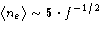 cm-3. A very rough
estimate for the filament filling factor of
cm-3. A very rough
estimate for the filament filling factor of  would suggest a
mean electron density in the filaments
would suggest a
mean electron density in the filaments
 cm-3, easily consistent with [SII] doublet ratios in the low-density limit throughout much of the large
volume of outer filaments. This mean density implies a filament mass
cm-3, easily consistent with [SII] doublet ratios in the low-density limit throughout much of the large
volume of outer filaments. This mean density implies a filament mass
 M
M distributed in a volume
 pc3, and a kinetic energy in the ionized
filaments
pc3, and a kinetic energy in the ionized
filaments  ergs. These values are consistent
with those first computed by [Lynds & Sandage 1963],
ergs. These values are consistent
with those first computed by [Lynds & Sandage 1963],  Mand
Mand  ergs, respectively. The entire mass of
outflowing gas is estimated to be a couple orders of magnitude larger
([Heckman, Armus, & Miley 1990]). Note that the kinetic energy in the filaments is only
about one percent of the estimated input supernovae energy (
ergs, respectively. The entire mass of
outflowing gas is estimated to be a couple orders of magnitude larger
([Heckman, Armus, & Miley 1990]). Note that the kinetic energy in the filaments is only
about one percent of the estimated input supernovae energy ( ergs; [Watson, Stanger, & Griffiths 1984]).
