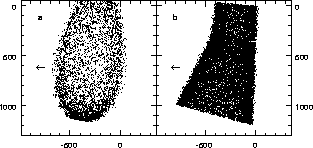
For our initial model, we used rounded bubble geometries, given by the spherical functions,
 |
(4) |
 |
(5) |
We then executed a series of Monte-Carlo simulations for each velocity law, varying bubble parameters such as opening angle, inclination angle, and inner and outer truncation radii. The conclusion reached from this set of simulations is that the rapid divergence of the velocity components in the southern outflow cannot be reproduced by a single bubble, at least not without invoking highly contrived velocity profiles for the wind. Studies of the minor axis x-ray distribution are similarly unable to model the emission with a single bubble or cone (e.g., [Suchkov et al. 1996]).
Morphologically, one can divide the southern region of split lines
into two separate velocity regimes: the region within approximately
200 pc of the nucleus, where the split line components are separated
by  50 km s-1, and the region beyond 500 pc radius, in which the
components are separated by a much larger, but still relatively
constant, projected value of 300 km s-1. The inner component is
not observed north of the galaxy, presumably because the split lines
cannot be resolved at a sufficiently small radius due to the
intervening inclined disk of the galaxy. Note that the H
50 km s-1, and the region beyond 500 pc radius, in which the
components are separated by a much larger, but still relatively
constant, projected value of 300 km s-1. The inner component is
not observed north of the galaxy, presumably because the split lines
cannot be resolved at a sufficiently small radius due to the
intervening inclined disk of the galaxy. Note that the H and [NII] flux maps (Fig. 1) also suggest the presence of two
distinct regions, as the line flux drops sharply at the same radius at
which the velocity components rapidly separate (500 pc).
and [NII] flux maps (Fig. 1) also suggest the presence of two
distinct regions, as the line flux drops sharply at the same radius at
which the velocity components rapidly separate (500 pc).
We therefore performed another set of Monte-Carlo simulations, this time using a double cone geometry, given by the cylindrical function
 |
(6) |
 parameters determine the
opening angles of the cones, while the z0 parameters control the
radial extent of the cones through truncation. Again, we superimposed
both radial and normal (i.e., perpendicular) velocity laws, but
determined in the end that a velocity vector tangential to the cone
surfaces provided the best match to the observations and was most
easily understood physically, in terms of material entrained by the
high-velocity wind. An additional parameter was used to smooth the
abrupt projected velocity transition where the two cones meet (at
z=350 pc).
parameters determine the
opening angles of the cones, while the z0 parameters control the
radial extent of the cones through truncation. Again, we superimposed
both radial and normal (i.e., perpendicular) velocity laws, but
determined in the end that a velocity vector tangential to the cone
surfaces provided the best match to the observations and was most
easily understood physically, in terms of material entrained by the
high-velocity wind. An additional parameter was used to smooth the
abrupt projected velocity transition where the two cones meet (at
z=350 pc).
After performing simulations over a range of cone sizes, inclination
angles, opening angles, and velocity laws, we derived the final model
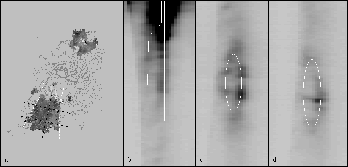
shown in Figure 12. Parameters of the cones which best
fit the observations are given in Table 3. The inner
``cone'' is almost a cylinder of radius equal to the injection zone
( pc), with a small, but non-zero, opening angle. The outer
cone has an opening angle of approximately 25o, in relative
agreement with the ``small'' opening angle models of [Bland & Tully 1988] and
[McKeith et al. 1995]. Models in the ``large'' opening angle regime (e.g.,
60o; [Heckman, Armus, & Miley 1990]) do not match the observations, requiring
excessively low intrinsic velocities and a larger projected spatial
extent for the outflow region (see Fig. 12a). A large
opening angle for the primary outflow cone also produces substantially
skewed Doppler ellipses in spectra perpendicular to the outflow axis.
This effect is due to the slit cutting through the back and front of
the cone at different nuclear radii, and is not observed in our
synthetic spectra (see Figs. 12c and 12d).
pc), with a small, but non-zero, opening angle. The outer
cone has an opening angle of approximately 25o, in relative
agreement with the ``small'' opening angle models of [Bland & Tully 1988] and
[McKeith et al. 1995]. Models in the ``large'' opening angle regime (e.g.,
60o; [Heckman, Armus, & Miley 1990]) do not match the observations, requiring
excessively low intrinsic velocities and a larger projected spatial
extent for the outflow region (see Fig. 12a). A large
opening angle for the primary outflow cone also produces substantially
skewed Doppler ellipses in spectra perpendicular to the outflow axis.
This effect is due to the slit cutting through the back and front of
the cone at different nuclear radii, and is not observed in our
synthetic spectra (see Figs. 12c and 12d).
The inner and outer cones are inclined toward the observer by
5o and 15o, respectively, roughly aligning
the back sides of the two cones (see Fig. 11b). This
is required to explain the lack of a sharp velocity gradient in the
low-velocity component (LVC) at a radius of 350 pc, as is observed in
the high-velocity component (HVC). In addition, since the LVC
exhibits small but non-zero projected velocities, the back sides of
the cones must be at a slight angle to the plane of the sky. These
inclination angles agree with previous estimates (e.g., [Burbidge, Burbidge, & Rubin 1964];
[Hennessy 1996]). While the observed velocities of the HVC could be
duplicated with smaller cone opening angles and a larger inclination,
the low velocities of the LVC require small inclination angles.
Initial attempts to model the kinematics of the outflow with a constant velocity law, i.e., using only the simple double-cone geometry to reproduce the observed velocity structure, were not successful. Figure 10 illustrates that both velocity components in the south and north exhibit non-zero slopes in the position-velocity plot. This can be understood as either a continuous change in the intrinsic gas velocity or as a change in the projected velocity through a continuous change in the outflow cone geometry. The latter case implies that both sides of the outer cone are constantly bending toward the observer, producing a slowly increasing projected velocity with radius. A gradually increasing intrinsic wind velocity is probably necessary as well, and can be understood from a physical standpoint. Buoyancy effects in the hot wind from the decreasing disk density with scale height, decreasing wind densities from the lack of collimation at larger radii, and other effects contribute to produce wind velocities that increase with radius in standard galactic wind models (e.g., [Chevalier & Clegg 1985]; [Suchkov et al. 1994]). After testing a number of stronger power-law expressions for the gas velocity dependence on radius, we finally chose the simple linear model given in Table 3. Together with a constant cone opening angle, this intrinsic velocity structure produces linear projected velocity gradients that correspond well to those observed in Figure 10. The intrinsic velocities of the gas range from 525 km s-1 near the nucleus to 655 km s-1 at a radius of 1 kpc. These velocities are comparable to the escape velocity for M82 (see Table 1), implying that the most distant entrained filaments are not bound to the galaxy. This conclusion is also supported by the large radial extent of the fast wind itself, as seen in soft X-rays, along the minor axis.
Just as the outflow cones are not aligned with the minor axis of the
galaxy along the line of sight, neither are they aligned in the plane
of the sky. The region of split H lines constitutes a cone on the
sky with the expected opening angle of 25o, but with a
position angle of 165o, approximately 15o greater
than what the literature (e.g., [McKeith et al. 1995]) had previously defined
as the ``outflow axis.'' The cone axis is rotated 100o from the major axis of the galaxy, and places the eastern edge of the
cone almost directly parallel to the minor axis. In fact,
Figure 12a illustrates that this eastern edge is quite
pronounced, both in the split emission lines and in the H flux
observed from the inner collimated zone. This suggests that the
tilting of the outflow cones in the plane of the sky has been produced
by a relative density enhancement in the eastern lower halo which
maintains collimation of the wind even as it fans out toward the west
and toward the observer.
While the large outflow cones appear to originate east of the galaxy's
minor axis, a small region of split lines is also observed on the
western edge of the collimated zone, approximately 300 pc from the
nucleus. The morphology of the H and [OIII] flux maps
(Figs. 1 and 2) indicates that this
region constitutes a small bubble on the side of the larger outflow
structure. We clearly see an enhanced rim of H emission around the
bubble, and split lines within it.
Recalling again the identification of two outflow ``streams'' in the
[OIII] flux map and the [NII]/H ratio map (Figs. 2 and
4), one might expect a more substantial outflow from
the western half of the nucleus, or at least a more
centrally-positioned outflow cone. However, it appears that gas
densities on the western side of the lower halo are substantial enough
to keep the western stream from expanding into a cone. The stream
appears to bend toward the west in the [OIII] flux map
(Fig. 2), and the only expanding structure that we
observe is the one small bubble.
But at larger radii, the ambient density toward the west must drop
relative to the eastern side. While the outflow remains tightly
confined to the east, even beyond the collimated zone, certain
Fabry-Perot maps show evidence of variations in the western side of
the outer outflow cone, suggesting a more azimuthally-extended
morphology there, e.g., break-out into a less dense region. For
example, the H velocity map (Fig. 3) reveals high
velocity clumps at radii of 1 kpc that are distributed westward
from the sharp eastern edge over almost 90o in azimuth. These
clumps are clearly associated with the outflow, and can also be seen
as the blue-shifted emission just west of the split line region in our
most distant outflow cut, Figure 12d. The fact that
this gas exhibits smaller velocities in panel c of this figure
illustrates that kinematical effects from disk rotation are greater
closer to the disk. In contrast, the emission immediately east of the
split line region lies at effectively the same velocity in both panels
c and d of Figure 12, as this coincides with the sharp
collimating edge on that side of the outflow. The spatial structure
of the H velocity map (like that published in [Heckathorn 1972]) also
suggests the presence of rotating disk material that has been
entrained and gradually diverted to the outflow.
To summarize, the inner 350 pc of the outflow constitutes a flow down
a pipe. The outflow is collimated, presumably by ambient and
entrained disk material, and highly inclined to our line of sight,
such that the observed radial component of the flow velocity is only
50 km s-1. Beyond 350 pc, however, the collimation weakens and
the outflow expands rapidly as a cone of emission with an opening
angle of 25o and a projected front-to-back velocity separation
of approximately 300 km s-1. This expansion is preferentially toward
the west and toward the observer. A linearly increasing intrinsic gas
velocity with an initial value of 525 km s-1 and a gradient of
0.13 km s-1 pc-1 matches the observations well out to a radius of
a kiloparsec.
The line-splitting phenomenon indicates that the H-emitting
filaments are produced on the surface of the outflow cones, at the
interface between the wind and the ambient halo material. In addition
to the minor axis velocity structure, this model explains the
increased flux within the collimated region (see
Fig. 12a) as a result of an elevated density with
respect to the outer expanding cone ( ). An
increased density in the innermost regions has also been indicated
observationally by the ``filling in'' of the line profiles at those
radii (e.g., [McKeith et al. 1995]).
). An
increased density in the innermost regions has also been indicated
observationally by the ``filling in'' of the line profiles at those
radii (e.g., [McKeith et al. 1995]).
While the inner bubble has an extremely small opening angle, we find
that an outer cone of opening angle 20o-30o fits
the data most closely. This range agrees well with the ``small''
opening angle values found by other authors (e.g., 30o;
[McKeith et al. 1995]). Our observations do not support the ``large'' opening
angle regime (e.g., 60o; e.g., [Heckman, Armus, & Miley 1990]).