and [NII] (see Fig. 3). The well-established disk
inclination angle of 81.o5 ([Lynds & Sandage 1963]) and the increased opacity
toward the northern filaments clearly establishes the large-scale
kinematics as arising from outflow (cf. [Elvius 1972]; [Solinger, Morrison, & Markert 1977]).
Second, the optical emission lines split into two distinct velocity
components in large regions along the minor axis of the galaxy. The
velocity structure of the individual components, as well as the
difference between them, provides convincing evidence for the presence
of outflowing gas along the minor axis of M82 ([Axon & Taylor 1978]).
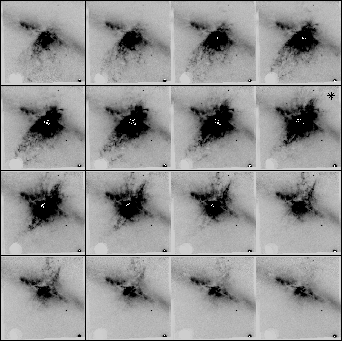
Figure 9 illustrates the velocity structure of the
H-emitting gas in M82, as observed in the frames of the Fabry-Perot
data cube. Both minor-axis outflow lobes span velocity ranges
exceeding
and [NII] (see Fig. 3). The well-established disk
inclination angle of 81.o5 ([Lynds & Sandage 1963]) and the increased opacity
toward the northern filaments clearly establishes the large-scale
kinematics as arising from outflow (cf. [Elvius 1972]; [Solinger, Morrison, & Markert 1977]).
Second, the optical emission lines split into two distinct velocity
components in large regions along the minor axis of the galaxy. The
velocity structure of the individual components, as well as the
difference between them, provides convincing evidence for the presence
of outflowing gas along the minor axis of M82 ([Axon & Taylor 1978]).
Figure 9 illustrates the velocity structure of the
H-emitting gas in M82, as observed in the frames of the Fabry-Perot
data cube. Both minor-axis outflow lobes span velocity ranges
exceeding  km s-1, overlapping at the systemic
velocity.
km s-1, overlapping at the systemic
velocity.
We now describe our attempts to understand the complex dynamics of the
outflow in M82 with the aid of kinematic models. We have extracted
one-dimensional velocity cuts and synthetic two-dimensional spectra
from the Fabry-Perot data cubes. These cuts have been made relative
to the outflow axis, at an estimated position angle of
 150o (85o relative to the major axis of the
galaxy; [McKeith et al. 1995]). While some authors have argued for a
spherical wind in M82 (e.g., [Seaquist & Odegard 1991]), most recent models find
evidence for a bipolar outflow, usually in the shape of cones with
opening angles much less than 90o. This is borne out by our
study: the line flux, splitting, and ratio maps all exhibit marked
azimuthal variations indicative of an aspherical outflow morphology,
strongly weighted toward the minor axis of the galaxy. Studies of the
supernova distribution (e.g., [Kronberg, Biermann, & Schwab 1985]) and other disk
observations (e.g., [Achtermann & Lacy 1995]) indicate that even the central
injection zone is probably not spherical, but rather in the form of a
flattened disk, with dimensions 600 pc wide and 200 pc
thick.
150o (85o relative to the major axis of the
galaxy; [McKeith et al. 1995]). While some authors have argued for a
spherical wind in M82 (e.g., [Seaquist & Odegard 1991]), most recent models find
evidence for a bipolar outflow, usually in the shape of cones with
opening angles much less than 90o. This is borne out by our
study: the line flux, splitting, and ratio maps all exhibit marked
azimuthal variations indicative of an aspherical outflow morphology,
strongly weighted toward the minor axis of the galaxy. Studies of the
supernova distribution (e.g., [Kronberg, Biermann, & Schwab 1985]) and other disk
observations (e.g., [Achtermann & Lacy 1995]) indicate that even the central
injection zone is probably not spherical, but rather in the form of a
flattened disk, with dimensions 600 pc wide and 200 pc
thick.
The specific velocities predicted by [Chevalier & Clegg 1985] do not agree with our
observations. An estimated supernova rate of 0.3 yr-1
([Rieke et al. 1980]) yields an outflow velocity from their model of
2000-3000 km s-1 at the edge of the starburst injection zone. This
value is several times larger than the deprojected velocities observed
at optical wavelengths ( 525-655 km s-1; see below) on much
larger scales. However, the extensive radio continuum halo
([Seaquist, Bell, & Bignell 1985]; [Seaquist & Odegard 1991]) could arise from synchrotron radiation due
to a population of relativistic electrons, as they are transported
outward in a wind at velocities in the range considered by Chevalier
& Clegg. The relationship between such a wind and the slower, denser
minor-axis outflow seen at optical and x-ray wavelengths remains
unclear. We suspect that much of the H filamentation arises from
large-scale shocks from a high-speed wind plowing into the gaseous
halo and entrained disk gas. Only a small fraction of the total wind
energy is encompassed by the radio halo (2%; [Seaquist & Odegard 1991]).
525-655 km s-1; see below) on much
larger scales. However, the extensive radio continuum halo
([Seaquist, Bell, & Bignell 1985]; [Seaquist & Odegard 1991]) could arise from synchrotron radiation due
to a population of relativistic electrons, as they are transported
outward in a wind at velocities in the range considered by Chevalier
& Clegg. The relationship between such a wind and the slower, denser
minor-axis outflow seen at optical and x-ray wavelengths remains
unclear. We suspect that much of the H filamentation arises from
large-scale shocks from a high-speed wind plowing into the gaseous
halo and entrained disk gas. Only a small fraction of the total wind
energy is encompassed by the radio halo (2%; [Seaquist & Odegard 1991]).
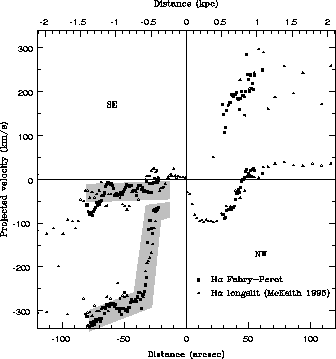 |
In modeling the bipolar outflow in M82, we model the individual line
components rather than flux-weighted velocity profiles. In
Figure 10, we show the velocities of line fits to the
dual H components along the minor axis of the galaxy. While the
northern outflow components show a relatively constant projected
separation of 300 km s-1, the southern region of split lines
reveals an intriguing variation. Within 200 pc south of the nucleus,
where the favorable inclination of the disk allows us to measure line
profiles closer to the starburst, the individual components of H are separated by a much smaller velocity, comparable to our resolution
(50 km s-1). Between 200 and 500 pc from the nucleus, the
components rapidly diverge, remaining at a constant separation of
300 km s-1 beyond 500 pc. Maps of the line component splitting
reveal a separation of this order throughout the spatial extent of
both lobes. Also plotted in Figure 10 are fits to the
H profiles from the long-slit optical spectra of [McKeith et al. 1995],
which clearly confirms our observed minor-axis trend in the line
splitting. An identical radial trend is seen in the [NII] line
components along the southern outflow axis, but is not shown in the
figure.